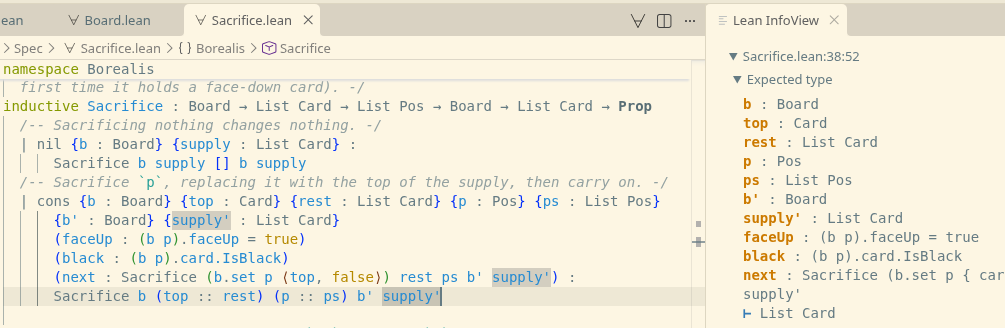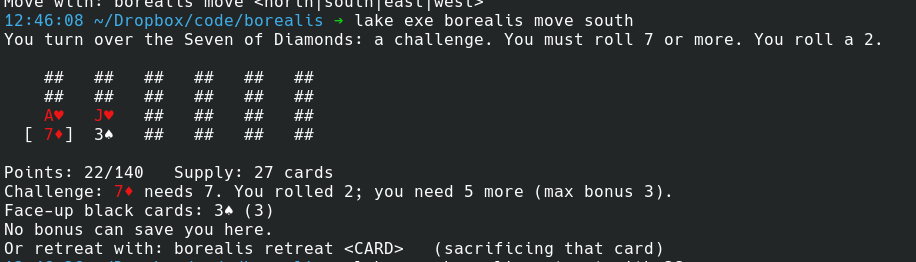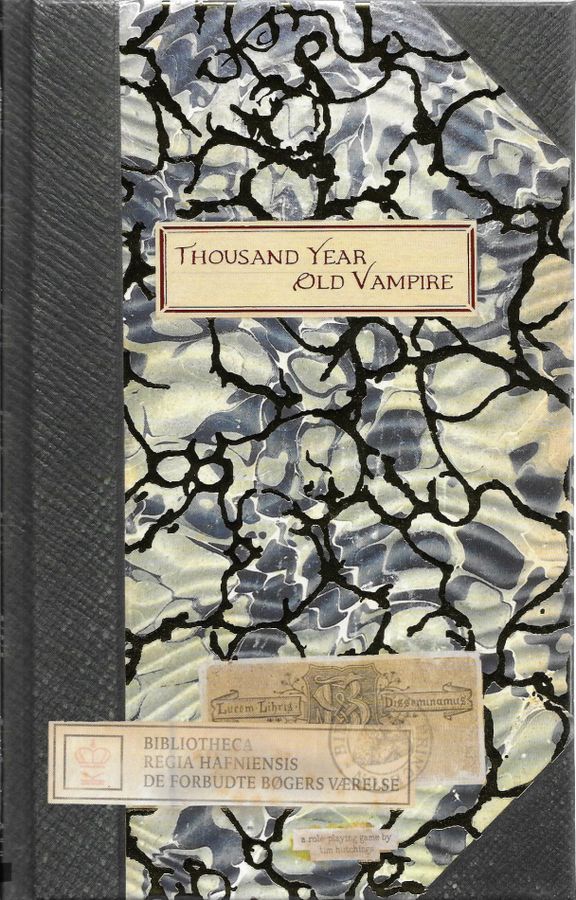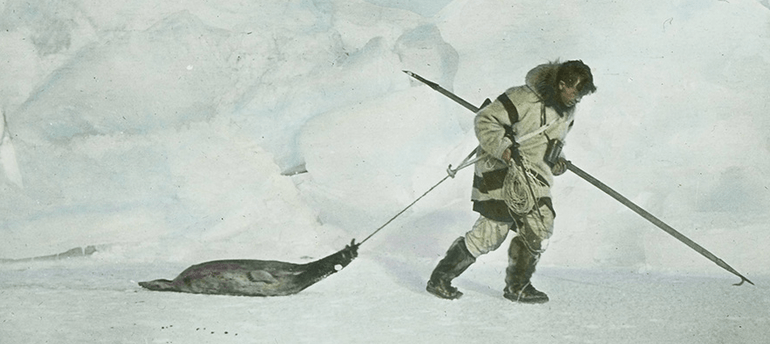
I recently discovered the concept of a journaling RPG, which can be a tool for creative writing. In Act I of these posts I narrate this discovery in more detail. In Act II I narrate how I finally got around to playing one, called Borealis, by overengineering a Lean implementation. As promised, the third post in this series is a transcription of the journaling I wrote in response to the game prompts. (You can read just this post standalone if you want.)
I’ve added the intro text from the game, since that’s essential for understanding the story. I won’t explain all the rules of the game, but they determined whether a given story beat went well or poorly. During gameplay, you flip over cards and reference their corresponding prompt from the game booklet. You start out with two safe cards, the Three of Spades and Six of Spades, and I’ve copied their text here. I also copied the relevant prompts for the later cards I pulled, but I wrote the journal such that those are actually not essential to understand the story. In some cases I kinda ignored part of what the prompt said, to better fit how I felt the story was going — this is considered a good thing to do in journaling RPGs.
Normally I would do a bunch of editing, major or minor, to get a short story into a state that I was very happy with. But I think it’s fun to see how this one turned out exactly as it happened from the gameplay. So the below is not edited at all. I did a tiny bit of retro-editing during gameplay.
The transcript
“This day you become one with the land,” said Elder Mishan. Her wrinkled face looked stern as she repeated the words as she had for all those of the People around us both, just as had elders before her back to before even our oldest writings. “This day you walk with winter, and winter shall learn your worth. May Boreas watch over you and his wind bring you home safe to us.”
I glanced at my mother and father, standing proudly at their place in the circle, the brand of their own walks clear against the skin of their clasped hands. For a sudden awful moment my mind was empty, and I had no idea what I was supposed to say.
“I shall walk with winter,” I said, the words coming back to me, and I remembered my brother standing here on the altar stones reciting the same. “I shall walk in Khione’s care. I shall harm none, neither plant nor tree, bird nor animal. And by this sign shall the winter know me and learn my name and see my worth. All this I promise to you.”
There was a brief intake of breath from everyone. Promise made. And now I had to keep it. The circle parted and my boots crunched against the snow as I set out to find the Borealis.
[Three of Spades]
Your maelnra, or walking stave, is the key tool of the People. Sharpened at one end and carved with runes of knowledge and protection, it can be used to drive through ice, as a pole for a bivouac or skis, or to hold up a weary traveller as well as a myriad of other things.
[Six of Spades]
Your sealskin coat is lined with fur and treated with Elder Imelion’s finest unguents to keep the winter out and you inside, as warm and dry as possible.
As soon as my family faded into the distance I began to feel an immense sense of regret. Not regret in leaving, but regret in not having asked more about what I will experience. Somehow I suddenly feel like I have no idea what will happen, or when I will even know when I’m supposed to do something different. What if I just walk and walk forever, until I freeze? I already know that I won’t go back unless I succeed. It is who I am, but that doesn’t stop it from filling me with adrenaline at the thought.
With only my coat and maelnra, I try to remain calm and walk on.
[Jack of Hearts]
A roaring sound chills you to your bones as you realise with horror that ahead is an ice bear, and it is protecting cubs. The bears are formidable opponents themselves and can act in frenzied rage to defend a family: find a way to proceed, if you can!
My fretting over whether anything will even happen was immediately shown foolish. Though the icy world looks barren, we know it is not. It holds great danger, and there is little natural danger greater than that of an ice bear.
I know not whether she knew the People were close, or whether it is bad luck. But my journey got very desperate very quickly. She does not seem calm or healthy herself. Most animals know that men are a great threat to them, and will run away. But if they are starving, they may attack themselves. And attacking she is.
She runs toward me at a full sprint. My heart sinks deep into my stomach. I can run down a glazelle through persistence, but almost all animals are faster at a sprint than men. And so I know there is no running from her. I must fight.
I meet her challenge, and scream at full volume, bolting directly at her. If I’m lucky, she will be more scared than I, and stop her charge. I am not lucky.
She saw me from a moderate distance, and continuing to run at the bear requires me to renew my commitment over in my heart. Finally, after agonizing seconds, she is within spearing range. Mercifully a bear will not throw it back at you, so it is a safe try. I throw with all my strength, and foolishly, at the cost of control. My maelnra plunges into the snow beside her.
She banks left but keeps barreling toward me. In desperation I try to evade but it’s clear that I must make it past her to get to my maelnra. The hopelessness of my situation is so simple, there is little else to do. I run at her, and as we are about to collide, she jumps to land on me, and something in my heart tells me to dive. I jump under her and roll. The great bear, body emanating heat and musk, flies just over me. As I get back on my feet and bolt toward my maelnra, I realize her back claw has caught on my coat, and it pulls off me swiftly.
As I reach my maelnra and yank it out, I turn around to see the bear starting to trot away with my coat. She has dug her strong teeth into it. I throw again, injuring her, but the maelnra falls out, and she starts running away. It would be foolish to pursue. But I will not last overnight without warmth. A hundred yards away, I see her stop and chew up the coat. It is then that I realize she can smell the sealskin and oils of it. She must truly be starving to try to gain nourishment from it. And when she is done trying, the scraps will be of little use to me. I grab my maelnra again — now the only tool I have against the world — and trot in the opposite direction. I must test my luck again, for the other option is self-sacrifice.
[Ace of Hearts]
The snow grows deep and cold. Draw upon your experience of the ice lands to proceed.
Some of the People find rune-working the most natural thing, more natural than nature. For myself, it’s easier for me to forget that they even exist. I feel that my strength is my body, my strength is my cunning, and the trust that I have built with my family. If I am honest with myself (and I must be, here in the land of Boreas) I distrust the runes. I have seen the runes fail those I love. We have gone hungry because my Uncle trusted the runes, and we lost our third Brother because the runes deceived us. I cannot trust them as I strive to be trusted.
But I am also a fool. I am out here, essentially naked with just a sealskin and stave. Good workings, made for me with love by my trusted ones — but they are not enough. I forget the runes that make my stave a maelnra. I forget the most powerful tool I have.
“Remember,” my mother said, “the runes work not on belief, but on possibility. Do not convince yourself of something unknown to you. And do not forget to acknowledge the possible.”
She said this to me just before I became a man in body. (For I have not yet become a man in spirit.) It was an unusual thing for her to say; though she applies runework daily, she rarely speaks of it. Instead, her work speaks for her, in the way that it keeps her family warm and protected. But that day she expressed that wisdom which I will never forget. Or at least, there will always be a time when I recall it. That time will not always be the fortunate one.
So with the feeling of the rune lines under my freezing palm, I continue walking forward, and open my mind to the possibilities. I search the horizon, I look at the snow at my feet. And I wait.
[Seven of Diamonds]
Huddled in the snow is the frozen form of another traveller. You hurry to their side but this person is long, long gone; another walker with winter, perhaps, but less successful? And then as the frigid form turns its face to you and its eyes flood with a chill blue light you realise that this is how it hunts…
And for my watching, the runes do not reward me. Over the next drift is a huddled body in a tattered coat, not like mine, but one much older. Out of instinct I run toward the Person. No doubt they are long dead. I see in my mind the possibility — is this from the runes? — of taking the coat. At least then it could serve the living. As I approach the body, I place a hand on its shoulder. Suddenly it falls over and my heart skips a beat. No harm done, but I silently chastise myself.
Then I see the eyes. The eyes of the body are blue. Not the blue of eyes, but the blue of the glaciers, vibrant and threatening. I scream, jump back, and run away. No good can come from this disfigured body, if it was even a Person to start with. I run away until I am over the next snowdrift, out of sight of the pale blue eyes. I cannot deny that no harm was done to me, but I do not feel more inclined to trust the runes.
The runes under my palm. Except they’re not. I realize in this moment, in what must be my lowest point, that I have left my maelnra where the body lies. How could I have forgotten my only remaining tool? If I ever see my family again, it will not be due to my worth. I must go back.
[Ten of Diamonds]
Upright in a pillar of ice you find a sword, a weapon of war, designed for killing. Tentatively you touch its hilt, untrained in weapons, when a voice sounds inside your mind. “Pick me up! Wield me! Kill with me!” and you try to thrust the chill thing away as it batters into your thoughts, seeking to make you its unthinking warlike slave. Fight it off to continue!
I make my way to the top of the snowdrift and stop. I see a body. But it is not the body I saw before. I see a weapon. But it is not my maelnra.
What I see is the ice bear. Her coat is my sealskin. That which was crafted by my trusted, I have left in tatters. And into her body is plunged the maelnra, my maelnra, but it has turned to solid glistening ice from my betrayal.
This is not my lowest point. That has already happened, when I forgot the promise I made, less than one day ago. As the sun now sets behind me, sealing my fate, the words echo in my mind. “I shall harm none, neither plant nor tree, bird nor animal.” My first action was to harm the first living thing I saw. On that first encounter, I had forgotten my promise, and I had forgotten that there is always another possibility. I had forgotten the runes.
The winter now knows my worth, and my tears freeze to my face. I fall to my knees, and my wet face binds with the snow, the snow I have tainted with blood. This day I became one with the land.
FIN
Postmortem
During this game, I got quite a bad deck shuffle and pulled only challenge cards. This makes the story kind of brutal, but still pretty coherent. I would almost never write a tragic story like this, so being forced to do so was a good exercise for me.
On my first prompt, I legitimately forgot about the no-harm promise when I chose to attack the ice bear. The fact that this incepted an original sin that could explain my ultimate demise felt so lucky.
On the last card, I had lost the game according to its rules, so I had to end the story there. Instead of introducing all the new details from the prompt into this story that I knew was about to end, I mapped them onto what had already happened in the story.
Overall this was super fun. I won’t likely play this exact game again, but am eyeing several more whose setting aesthetics are more intrinsically interesting to me.