
From a civilization I’ve never heard of
I was immediately drawn to the stele, in a way that I always am but most people aren’t. It’s a flat rectangular slab, totally blank except for some random text on it you can’t read. Why would that be attention drawing, when the rest of the room is filled with a variety of colors, 3D shapes, depictions of animals and human expression? This particular slab is not even decorated. Not the slightest bit. The only thing that saves it from being the monolith from 2001: Space Odyssey is a very slight taper.
But exactly what excites me about it is the nature of writing itself, the intense abstraction it involves, and the motivations people had for inventing and learning such a craft.
When I approach to read the object label, the one part I can understand, it says “Marble stele with a Lydian inscription”. If I’ve ever seen “Lydian” before, I don’t recall it. Sometimes a category will have few enough things in it that one could reasonably learn what they all are, like countries in the world or taxonomic phyla (not that anyone would…). Sometimes a category has unreasonably many, like the number of cities in the world or taxonomic genera. And sometimes it will have just enough that you always feel tantalizingly close to knowing them all but never quite get it. Writing systems are in that third kind of category, for me.
While the Lydian script is understood to be an alphabet similar to Greek, the label goes on to tell me that the Lydian language itself has not been fully deciphered. So not only do I not know that this stele says, but in fact no living person on earth knows.
(It is in this moment that I wonder whether Large Language Models have been trained on this particular inscription, and the Lydian corpus as a whole, and whether, in the vast latent space of the model’s parameters, it has perhaps already arrived at a representation for the text that lies close to its correct semantic meaning in English. I could not myself investigate this question, but those working at frontier AI companies could. Thus it may be that some non-human on earth knows what this stele says.)
I stare at the inscription for a while. It is very cleanly rendered and preserved, such that if I wanted, I could easily identify the character set and transcribe it. I see a few instances of a character that looks like the Chinese character for king, 王. (Their similarity is of course entirely coincidental.) In this inscription it appears doubled, 王王, most of the time, but not always. I see another distinctive character that looks like if a tilde was a three-leaf clover instead of two. And I see another that is likely the ancestor of the letter A. I start searching for repeated sub-strings, to identify words repeated in the text. I find both a repeated word, and words which share a prefix. Maybe they’re different verb tenses or noun declensions. In a short inscription, repeated words are either extremely common like “the”, or they’re what the inscription is about, like a person’s name.
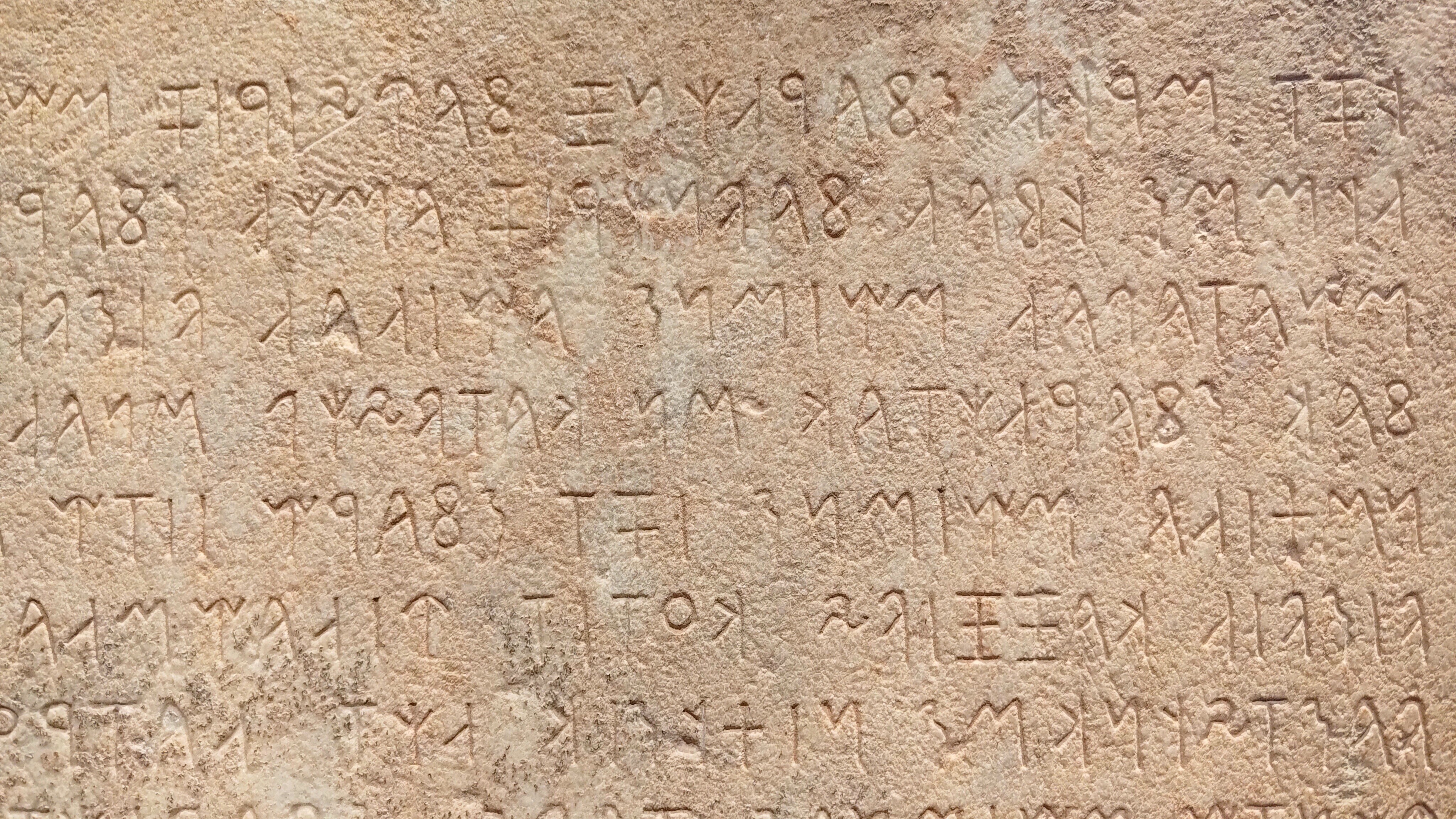
This is all very pointless of course, as academics will certainly have identified all such frequency patterns long ago. But I get the same joy out of it that one does from doodling a frog, even though humanity has mastered the art of depicting frogs. It’s also quite satisfying to know that, if I kept going, and tried with patterns that weren’t just sub-string frequencies, I would in theory converge on a full understanding of the content of the inscription — at least as far as remains objectively present in the corpus.
Almost all writing in the world is incredibly boring, repetitive, distasteful, or inane. This also goes for stelai, which are quite fond of telling you who owns what or how great the current king is. But I still find myself intimately in contact with a level of appreciation beyond what the authors of the inscriptions choose to write. Inventory tablets are brilliant in part because the sheep could never count themselves. And it’s better for the king to declare his greatness by word, thus dissuading potential pretenders, than to be forced to prove his greatness by blows.

