Are apples made of cells?

This is my post for day 2 of the Inkhaven writing retreat.

Like, probably, but I think this is an interesting and non-trivial question. I’m not actually 100% sure about the answer; I’m probably 97% sure of the answer. But the correct answer doesn’t actually affect the value of thinking about this question.

Even if you know a lot of biology, there is an explanation that a biologist could give about how apples are actually not made of cells which would, I claim, be pretty convincing. How much detail would they have to give before you believed them? Even if it turns out to be false, it’s good practice to know what it feels like on the inside to have your mind changed about something. Can you imagine what the biologist could say that would change your mind? Think about this for a second before reading on.

You learn pretty early on in biology class that all life is made of cells. (We’re not getting into the issue of viruses, here.) It’s pretty much what life is; cells are the level at which the replication occurs, so life begetting life is cells begetting cells.

But cells are extremely complicated and messy and made of lots of sub-parts. And they can produce bulk materials that are useful to the organism: materials which are not themselves made of cells. Tissues need to be made of cells in order to perform complex functionality that is locally responsive to the molecular conditions around it. Cells have the machinery to control what goes in and out, and control which genes get expressed when.

But not all parts of organisms need this.

  • Your hair and fingernails and outer skin layers are kind of cells but kind of not. They’re dead cells, flattened together and drained of most of their contents.
  • The enamel in your teeth is not made of cells. It just needs to sit there being a rock. This does come at the cost of self-repair, hence dentistry being a major category of medical care.
  • Bones are in large part made of minerals, which is to say, tiny rocks, which I would claim are not cells. But these minerals seem to be fractally mixed-in with the myriad organic operations of the bones, almost as though bones are perfectly calibrated to queer the made-of-cell/not-made-of-cells binary.
  • Your bladder is full of, let’s say, non-cellular fluid.

And some cells are very large. Eggs are often cited as large cells (though it’s very unclear to me whether this is true), with the ostrich egg being the largest. Could apples be giant, single plant cells? How sure are you?

So, what’s up with apples? Is there some minimal cellular machinery around the edges that packs in the sugars, pumping nutrients in through the stem, making sure the skin grows in proportion, with the bulk of the apple mass being undifferentiated acellular deliciousness? Or is it cell walls all the way through, crunching crisp copies of every chromosome?

If you were the first discoverer of cells, you would need to spend a while going around and checking different types of tissues before you could justify the generalization “all life is made of cells”. And I think fruit is a category where you would be less justified in generalizing to.

So how could you tell? Are there ways other than looking it up, or using a microscope?

The origin of writing is surprisingly unclear

This is my post for day 1 of the Inkhaven writing retreat.

History is often defined to have begun with writing. That is, something is considered history if we know about it because someone wrote it down. Otherwise, it is considered pre-history. We only know about pre-history by making inferences from physical evidence.

Before we go any further, the typical definition of a writing system is that it must be able to encode, physically and persistently, arbitrary speech from a language. Humans have been using physical markings and symbols to communicate specific concepts like “sun” or the names of kings for a much, much longer time than they have been using a full writing system.

The classic story is this;

The Sumerians invented writing first, around 3400 BCE, with cuneiform. The Egyptians followed suit shortly after, around 3100 BCE. It’s unclear to what degree the Egyptian invention of writing was caused by or influenced by cuneiform; they likely knew about it. Notably later, around 1200 BCE, the people of the Shang dynasty invented oracle bone script, which would evolve into modern Chinese. Mayan hieroglyphs extend back to 200 BCE, in a place so far away from Asia that its development is certainly independent.

So: four, maybe three, independent inventions of writing. I think this story is extremely cool and beautiful on its own. But the details of what we know and how we know it reveal a surprisingly rich space of other possible stories.

Disclaimer: I am not a professional in any related field and I find it surprisingly difficult to recover clear facts about these timelines from online research. Everything below represents my general impression more than any specific claims.

How old is it?

Archaeologists (and, to be fair, many scientists) seem to have a tendency to state that something is as old as the oldest existing positive example. This is understandable; there is a long history of people just claiming that stuff is really old, and getting fame and attention for that.

While archaeologists sometimes acknowledge that something could be older, they do not, as a field, seem to be attempting to collaboratively build a probabilistic model of how old things are, taking into account less crisp things like the existence of prerequisite conditions, or the occurrence of events which could have wiped out earlier evidence. Another way to say this is that they don’t seem to think in a very Bayesian way.

But sometimes, you pretty much just know how old something is, because you have records during its entire developmental process.

If you have lots of fossils of dinosaurs, and then lots of fossils of increasingly bird-like dinosaurs, and then lots of fossils of decreasingly dinosaur-like birds, and then lots of fossils of birds — you pretty much can just know how old birds are.

Similarly, we have found stone tools with a range of developmental sophistication going all the way from fancy obsidian daggers back to things that just barely look like deliberately broken rocks, with countless samples smoothing filling in the space.

With textiles however, they essentially all decay after a few thousand years at the absolute longest. So whether there was or was not 300,000 year old clothing, we would not find it.

Similarly, there seem to be tattoos on bodies as far back as the skin is still preserved.

For this reason, it seems to me like we can know exactly how old cuneiform is.

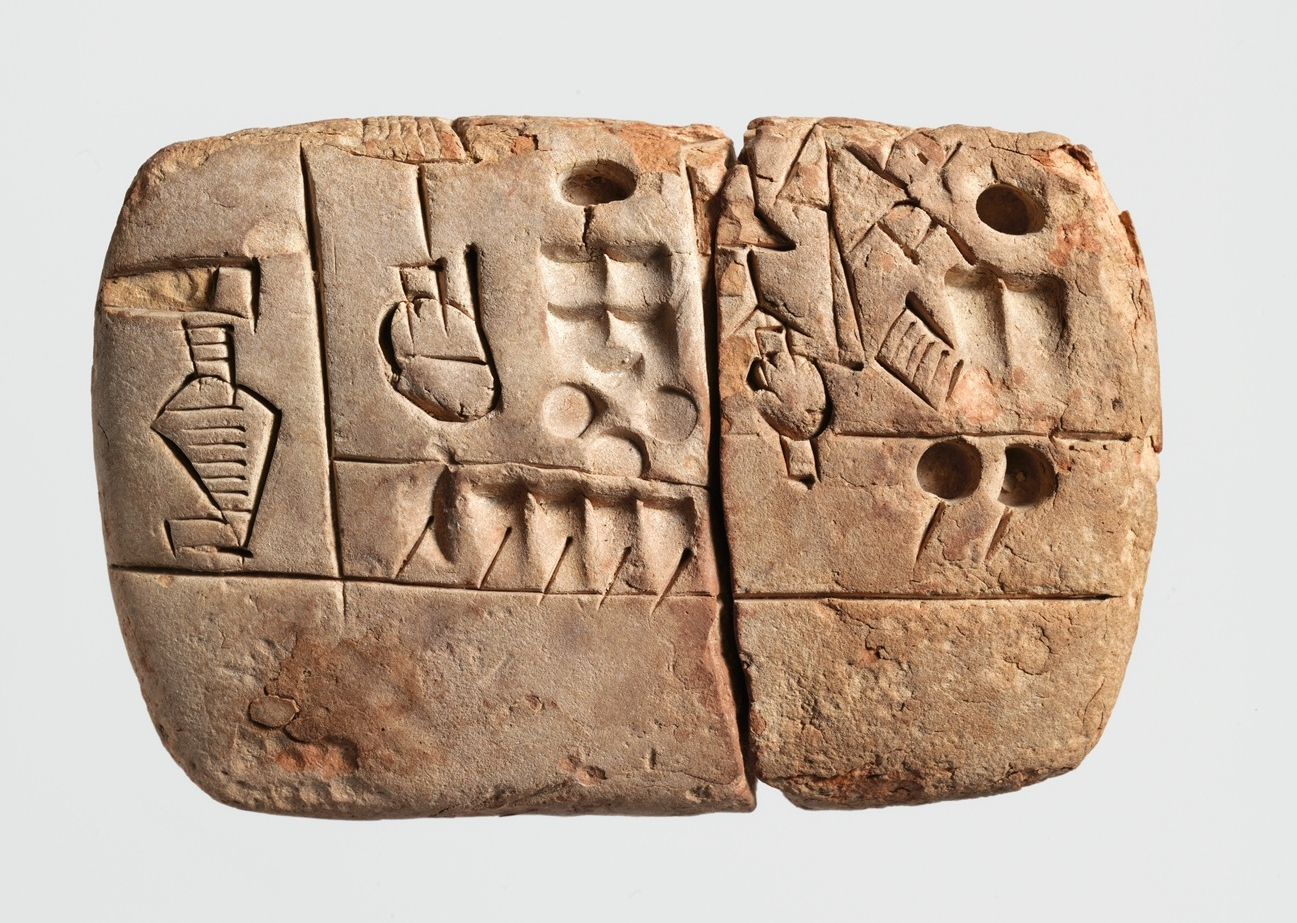
It all started in the 8th millennium BCE with clay balls called “bullae”, which were impressed with symbols that recorded goods exchanged. This evolved over time into simple seal impressions on flat tablets. The denoting of quantities and types of goods grew more complex over time. Pictographs began to be used for what they sounded like, and not just what they depicted. “Proto-cuneiform” is considered to have begun development around 3200 BCE, not reaching full writing system status until more like 2900 BCE. We have hundreds of tablets from this period,1 and a pretty good sense of how it developed.

Egyptian hieroglyphs seem to have a fuzzier record of their proto-writing period. Full writing emerges around 2800 BCE. There are some simpler uses of hieroglyphs dating back to the ink labels on jars from the tomb of King Ka from 3120 BCE, or the ivory tags from Abydos Tomb U-j from 3250 BCE. Given how close this is to the dates for cuneiform, I’m confused about why the consensus is confident that cuneiform was older.

In stronger contrast, oracle bone script, the ancient predecessor of Chinese, seems to have jumped into the historical record as a fully-formed writing system in 1200 BCE. I claim that this means that we have basically no idea how old Chinese writing is. The windfall of artifacts seems to be due to the rulers engaging in a particular practice of divination, leaving records of the query and answer on turtle shells and ox scapula, which are relatively durable. At roughly the same time,2 they started inscribing onto bronze vessels, which are extremely durable. If they were writing on paper, bamboo or silk before that, we wouldn’t see it. There are several artifacts which are thousands of years older than oracle bone script, claimed to be potential predecessors of it. But they are tauntingly sparse.

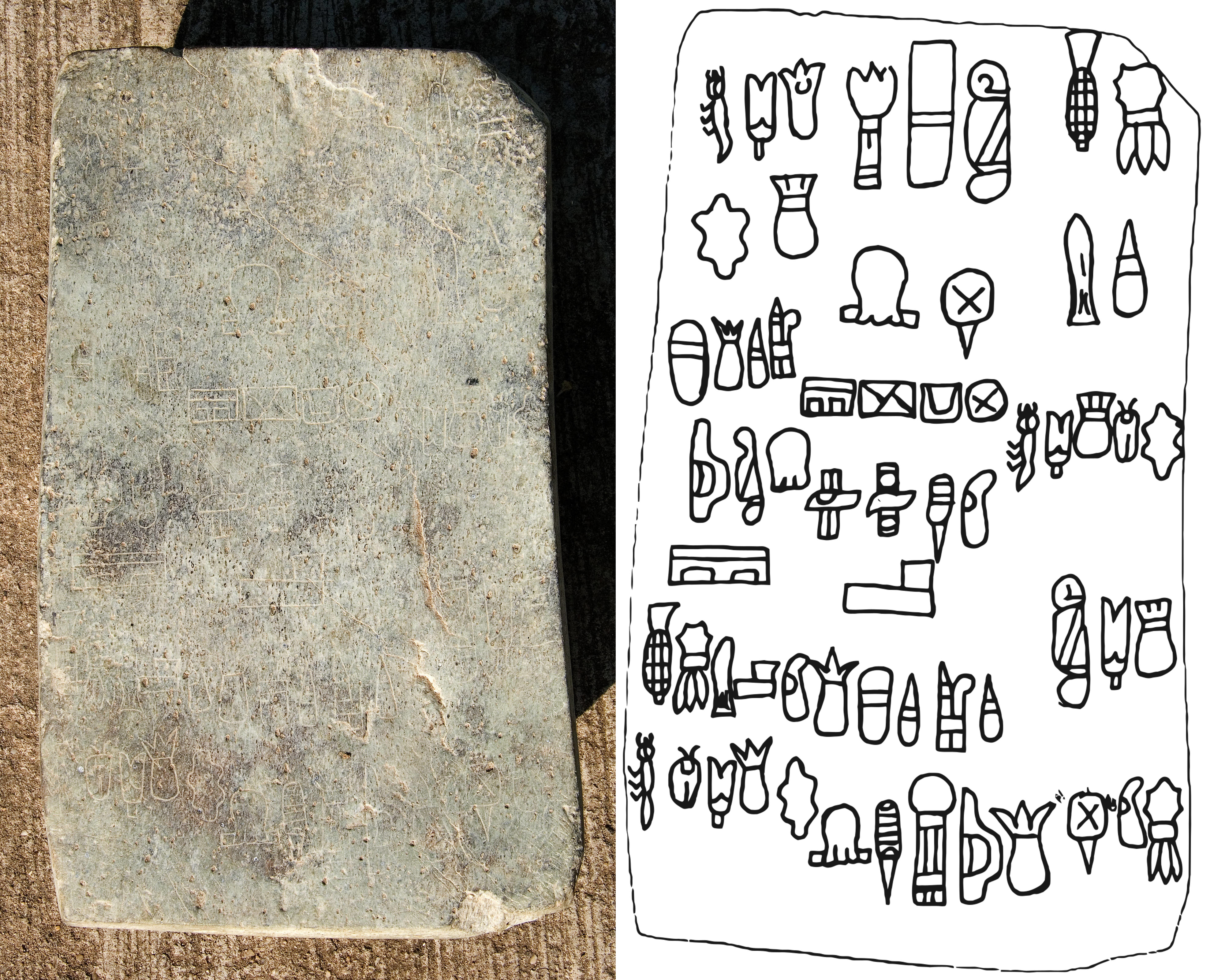
The history of Mayan seems far fuzzier still. It seems not to have originated with the Maya at all. Another script found nearby is Zapotec which, while obviously strongly related, is different enough that it is considered undeciphered. And there are a handful of much older artifacts that indicate that this family of scripts may have been developing as far back as the Olmec civilization. These artifacts seem to show symbols that are less likely to constitute a full writing system. But the intermediate record is so sparse that it’s hard to say much. All these artifacts are on stone; the most durable material, and also one of the most effortful to write on. We can be certain the writing was first developed on an easier medium.

Beyond these four script families, there are many other artifacts across the world that may represent independent inventions of writing, like the knotted cords of the Inca, the rongorongo glyphs of Rapa Nui, a cuneiform competitor, or the mysterious symbols on many Vinča artifacts, these latter potentially dating from 5000-3500 BCE.

When I look at all these facts combined, they seem at least compatible with many different histories. The blank spots in the chronology seem to contain plenty of space for unseen structure.

What does it mean?

It’s hard to say why I find it so compelling to know exactly how the origin of writing went down. In some sense, writing feels like humanity fulfilling its potential. Information is incredibly powerful. It can etch the world onto a grain of sand. It’s like a wormhole that teleports the past into the future. There was a brief period of history where no one on earth could read any of these four scripts. But true language has structure that reflects the structure of the world. Now, they can all be read again, in the majority. Although I do not think writing does much to preserve individual human souls from ultimate annihilation, I think it goes a long way towards preserving humanity.

  1. If you were thinking you’d heard there were hundreds of thousands of cuneiform tablets, those ones are from after the proto-cuneiform period. ↩︎
  2. Since oracle bone script and the bronze scripts are attested from almost the same time, I am also confused about why oracle bone script is universally reported to be the “oldest” form of Chinese writing. EDIT: I go deeper on this question in a future Inkhaven post. ↩︎

The Empty Tattoo

I’ve always thought it would be cool to have a tattoo. No, not “cool”; satisfying. To have a symbol that I like, that is meaningful to me, that I can carry around with me. I would put one on each wrist, because I would see them often, it’s a nice blank spot, and my hands are symbolic of my interaction with the rest of the world.

I am a person who is very interested in and aesthetically aligned with finding things that are singularly good in some way. What is the optimal way to make choices? What is the truth underlying all other truths? What is the best possible future? The most important thing? So when I think about getting a tattoo for myself, I don’t just think of getting a pretty design, or a character from a show, or a commemoration of a past event. I think, what is one message that I fully love? What symbol most represents me? What would be optimal to remind myself of so often?

I could look at it and take regular pleasure in the meaning of the thing. People I meet could ask about it, and I would get to excitedly tell them about the cool meaningful thing.

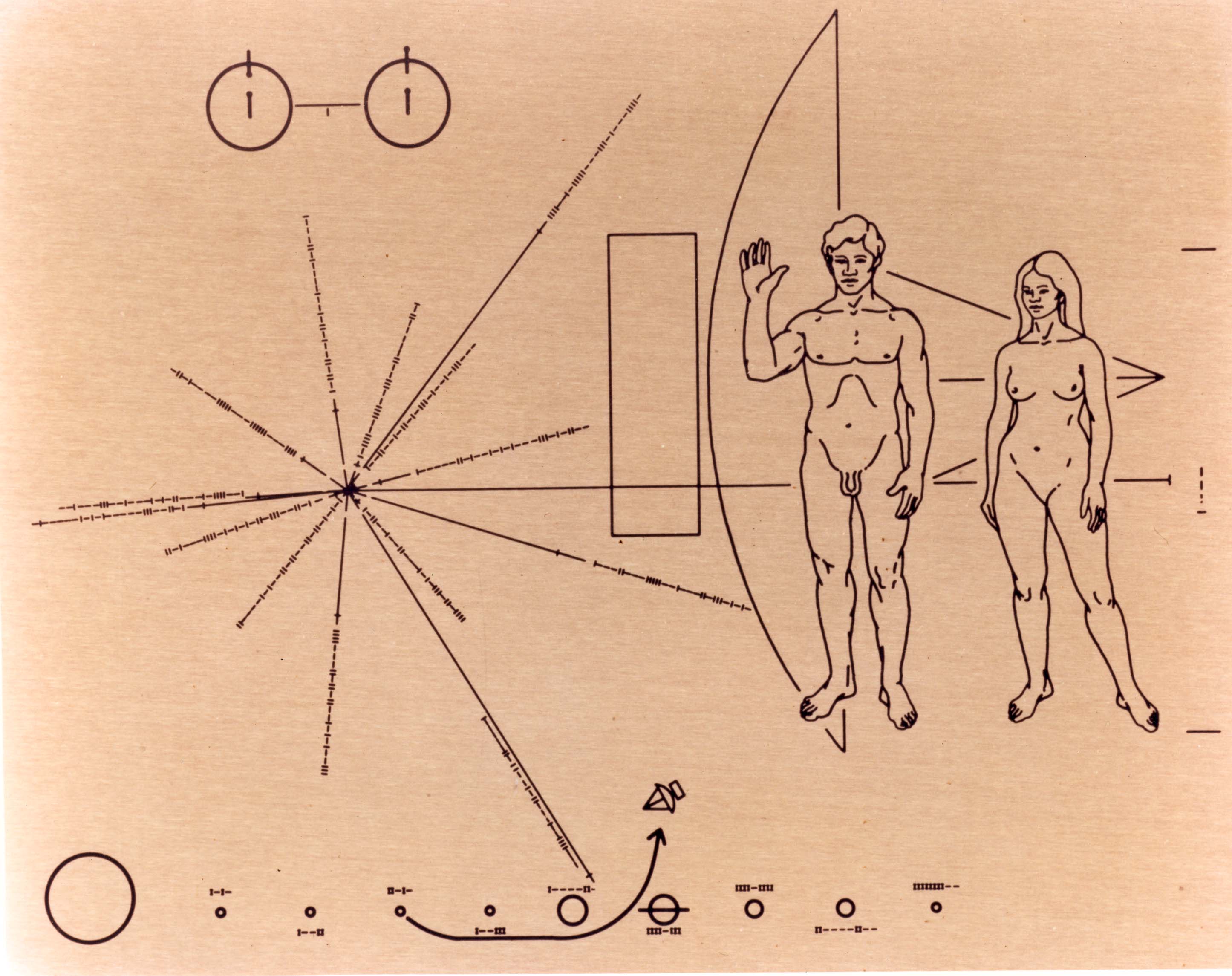
There are so many great things it could be: the earth; the earliest known writing; neurons; a depiction of Turing machines; of infinity, of an infinite future, of unbounded potential; of striving; of cooperation between sentient beings.

But, I don’t have one yet. And it’s because, well, I haven’t found the “right” thing. I haven’t found a concrete, visual expression of something that passes my bar for being permanently part of my experience.

I know, I know — “you’ll never find the perfect thing”, “nothing’s perfect”, “you’re missing the point of tattoos”, “don’t let the perfect get in the way of the good” etc. etc. But… I don’t think I’m falling into the failure mode that you might be imagining. I don’t feel anxious about getting something and then not liking it later. I’m not sure that there is a perfect thing. I just haven’t thought of anything that really excites me. If 50 years go by and I still don’t have a tattoo, I don’t think I’m going to regret it. I think I’ll just think, “well, I didn’t find the right thing, and that’s perfectly okay”.

But something occurred to me today; an alternative framing. I was pacing around my apartment, trying to make progress on my research. I was thinking about how, if an entity receives two different inputs, what does it mean when it takes two different actions, versus the same action? What does it mean when it takes two different actions, but which result in the same outcome? And at the same time, I was thinking about my cool coworker friend who helped me decide to get my ears pierced, and who also has lots of cool tattoos. I looked at my arms and thought about how I don’t have tattoos. And I thought; me not having a tattoo is one of the ways the world can look. What does it mean about the difference between this world and the one where I do have tattoos?

And then, I had the sense that it meant something positive rather than something negative. That it was the result of an action rather than an inaction. That is to say: I have a tattoo. The fact that I have not yet found a suitable symbol is a meaningful and enduring fact about me. The nothingness emblazoned on my arms is a direct causal effect of my continued search. I can look at my arms, and instead of thinking “maybe I should have gotten Turing machines tattooed there years ago”, I can think “there it is, there’s the symbol to myself that I am one who searches, one who is not satisfied”. And in fact that’s essentially what I do think when I look at my arms. Because when I think, “I still wish I had a tattoo” my immediate next thought is, “let’s think harder about what it could be”, which causes me to start thinking about potential essential expressions of ultimate meaning. This is essentially identical to thinking, “I still wish I understood the most important things… let’s keep trying to understand them”.

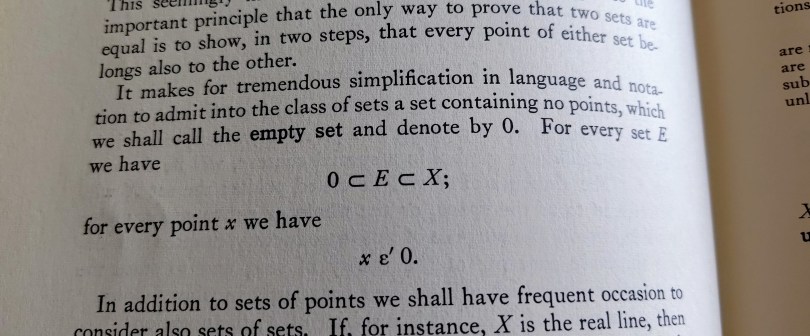
In almost all of modern mathematics, the objects of discourse are ultimately defined in terms of what are called sets. The number 5 is the set containing the numbers 1 through 4. A function is a set of pairs (where a pair is a set of two things), where the first thing (itself some kind of set) in each pair gets mapped to the second thing (another set) in the pair, et cetera. But if everything is in terms of sets, where does it bottom out? The empty set. The empty set is a perfectly valid set; it has no elements. Because nothing is in it, you don’t need to have a pre-existing type of object in order to define the empty set. You can start there.

So that’s my tattoo; the empty tattoo.1 It represents everything I’ve found so far that’s perfect; nothing. The fact that nothing is in it is meaningful, because I have been searching. There are other people who have no tattoo and who have not been searching. You can’t tell us apart by looking, but that’s okay, because I know who I am.

  1. Of course, many people have a tattoo of the empty set itself. But, well, that doesn’t feel right for me. The set containing only the empty set is different from the empty set itself. ↩︎

Orders of Magnitude

This piece is a speech that I gave for the 2020 SF Bay area secular solstice. Solstice was online this year, and a partial recording can be found here. This speech begins at 46:56. It transitions into the moment of darkness, the traditional “midpoint” of solstice where the stage is dark and you are left with your own thoughts for a brief period of time.


Every year, we gather and think about many different themes that are important to us. Many of these themes are about the very good, and the very bad.

We think about humanity’s past. We sing Bitter Wind Blown and reflect on what it would be like to have to light our own fires for warmth. We try to imagine what it would feel like not to know why it gets cold, or why we get sick, or whether there is anything we can do about it.

We think about the present. We share stories of humanity’s astonishing technological accomplishments and feats of cooperation over the last five thousand years.

And sometimes, we think about the present from another perspective. Beside our achievements we see stretching from the past into the present an unbroken thread of suffering, woven thick with the experiences of countless souls.

So at the same time, we must contend with the fact that we are standing on a rising pedestal, flung exponentially higher by our ancestors, and that also, all around us, unacceptable atrocities continue.

How are we to make sense of this? When confronted with the desire to understand everything, and the compulsion to ensure the prosperity of the far future; how are we to stretch our minds across both the enormous losses and enormous gains?

This is a challenge that is with us in normal times. This last year has brought a further complication to the picture. With pervasive fear of sickness, stuttering economies, and our institutions struggling to keep their heads above the water, it no longer feels like we are at the apex of human history.

To better understand these extremes, we need to deploy the tools of rationality.

In the third century before the common era, a man named Archimedes wrote an essay called The Sand Reckoner. The ancient Greeks, you see, had a term for a large quantity; a “sand hundred”. The idea was that, although one could see with the naked eye that sand consisted of discrete grains, enumerating all the grains in a sand dune, let alone an entire desert, was beyond possibility; beyond human abilities. But the mind of Archimedes soared above such imagined limitations. He invented a means of manipulating large numbers, which today we would call exponents, and with these he calculated upper bounds on the number of sand grains in the whole of the earth, and indeed, the sand-grain volume of the entire universe, as they believed it to be at the time. In this exercise, Archimedes had reckoned the sand. And in bringing the immensity of the sand inside himself, he also unleashed the mind of humanity onto the universe.

One virtue of rationality is precision. And sometimes, precision is less about knowing decimal places, and more about knowing what order of magnitude you’re on. Another virtue of rationality is scholarship. And the way that I know how to reckon with today’s immensities is to do research, and find statistics that tell me something about what order of magnitude we’re on. 

For example, the Spanish flu of 1918 killed somewhere between 20 and 100 million people. For comparison, malaria kills about half a million people per year, and COVID has killed 1.7 million people. 

In the second quarter of this year, the US GDP had the largest decline on record, and then the third quarter had the largest increase on record, although the net of those was negative. 

It took the world about a year to develop and begin distributing a vaccine. The previous fastest vaccine development was four years, in 1967.

These facts can be objects of meditation. They can be devices in your practice to understand the world around you, to orient your mind, and to choose future actions. Despite the clarity of specific numbers, it can take a long time to really understand what they mean. A lot of exposure is necessary to take these numbers inside yourself. My recommendation is to think about it lightly often, and deeply on occasion.

To think about it lightly often, perhaps form some associations that will let you be incidentally reminded of the good and the bad. For example, every time I see a plane in the sky, I just can’t help but stop for a second, follow its path through the sky with my eyes, and imagine all the people on board. It is truly a miracle that for a modest sum, each of those people can be safely hurled across the surface of this great earth, and in the meantime admire the tops of clouds.

In contrast, whenever I walk down the street and see a padlock, it reminds me that we have failed to solve basic coordination problems between people. While there still exist wars and police, or even fences and padlocks, we have not finished our work.

This is a careful balancing game; you don’t want to be so often optimistic that you lose your sense of urgency in building the future, and you don’t want to be so despondent that you lose your will to try. Minds vary in their makeup, so experiment at your own discretion.

For me, these associations are a light reminder, almost a subconscious one, which give me the opportunity to choose how deeply I want to reflect. The more you traverse the orders of magnitude, the more familiar they become, and the more you will be oriented to the exponential reality.

And tonight is a time to consider it more deeply. So for now, I will leave you with one more statistic on which to reflect in silence for the next minute. The global death rate is about 107 people every minute, or just under two people each second. This year, COVID has added about three deaths for each of those minutes.

[A pendulum clock begins ticking in the background. I blow out the candle and fade to darkness.]

The Airstones of Westmining

Just a little vignette inspired by my partner’s whimsical writing style.

Picture credit Lydia Zanotti.


Tikal runs out of the doorway of his little airstone abode, and takes a sharp turn down the street. He’s late, and he’s very upset with himself. He knew he needed to be there before the time tower tolled, and he knew the neighbor’s turtle-rooster croaked a street’s stroll before the time tower tolled. He remembered hearing the croak, but sky above knows what he did right afterwards. What he did wasn’t a street’s stroll. Instead the time towers toll transported him from his task-trance back into his room, and then his street-run began. As he flew, he was careful to watch the cobble-airstones, careful to watch his foot fall on each one, square in the middle, lest he stumble. He knew from personal experience that a fall is more bother than the extra running is worth.

As he ran, the airstone houses on each side of the street ticked on by. The houses on Wyael street (or on every street really) were all squished together, like little palm-cakes, packed too tight in a baker’s tray. The people of Westmining liked them that way, you see, nice and cozy, all holding each other up. If they’re all so similar though, how to tell them apart? That would be a problem (or might still be a problem for those not so good with hues) if it wasn’t for every plot being of a different colored sort. The airstone, you see, came in a great range of sights.

None of the sights were strong, not like the green of a field, the sky-above blue, nor anything approaching the crimson of a knee after a fall onto the cobble-airstone. No, they were all light-hearted sights, just a shift away from the grey that were all stones at heart. (Greystone is the purest stone, you see; good for not moving, and nothing else. And yes, I know what you’re thinking; blackstone is not the purest stone, it’s pure black alright, but someone had to add something to get there from grey, and it wasn’t more stone, that’s for sure. Don’t ask me about whitestone, we’ll get there when we get there.) So the airstone is quite light-hearted you see, being from above and all. So in its lightness it meanders away from just grey, and toward whichever hue it favors at its moment of shifting. North is red (or maybe you’d call it pink, since it’s light), south is green like the grass, east is blue, etc etc. So when a new citizen of Westmining builds an abode, they choose the hue of their liking, and up goes the abode.

But not too up, hopefully. The airstones need to be well-anchored of course, lest they seek to rejoin their kin in the Petracumulus mines. Tikal had never been to the mines. They were Very Dangerous, for adults only. And, you had to work your way up to handling the thinness up there. Tikal could only handle the normal air. The valley folk called the mountain folk “the up-dwellers”, but that was silly. The miners were the up-dwellers. The mountains were the bridge. The valley folk were down-dwellers, swimming in their thick air and marshy villages.

Tikal wasn’t sure he wanted to be a miner, but he was sure that the wanted to listen to what the miners had to say. Maybe he would be a pilot, sailing from tower to tower, learning all the lands from the above. Or maybe he would be a bridge builder, connecting rocky spires and islands of the Petracumulus. Despite what most of his friends thought, the mines weren’t for mining airstone; no, it couldn’t be used down below, it was much too light. (Besides, you don’t mine stone, you quarry it.) The airstone was a boon that the mountain people collected for their own cities while they cleared the way to the veins of other substances. Which others, Tikal wasn’t sure. Maybe he would learn that from the miners today, if he listened carefully (and if he could get there on time).

Worship

One year ago today the Notre Dame caught fire, burning down the entire roof and the spire. It has since been largely secured, but proper restoration work is still a long way off. After the fire, I wrote this short story for a contest. It features a post-singularity mind choosing to have a particular type of experience of the cathedral. It will tell you something of what it means to me, and perhaps some of what it means to humanity.


Throughout all the centuries, there has been no gesture as pure as the creation of the medieval cathedral. Built across so many generations and touched by so many hands, it was humanity itself that came to say, this is who we are.

That caught her attention. Her attention, slightly decentralized as it traversed the mindspace, wrapped up its threads and drew back together toward this one idea. She had been wondering lately, what had it been like to be human before the rise? What had they thought of the world and what it would become? What did it feel like in each moment, to be confronted with a life so bounded? And what did it feel like to be human?

Records of the past, though well-secured by now, were quite finite compared to the deluge of information that was continuously being added to the mindspace. One had to do a lot of analysis and guesswork to draw conclusions about the past.

So why were cathedrals so important to them? She knew about religion; humanity’s attempt to find meaning and purpose, metaphysically and ethically, in a world where they had little control over their environment or even themselves. In part, cathedrals were a concretization of a specific religion and its symbols. But in a bigger way, they had had an enduring and universal appeal.

Her first instinct was to consume all known information about cathedrals. Modern minds, being distributed, could do this very efficiently. But before she started, the thought occurred to her; maybe this would be more fun, and a better learning opportunity, if she tried to make inferences only from the artifacts in question. She could treat the task archaeologically.

She loaded up renderings of all cathedrals that had managed to be information-theoretically preserved. Whether something was preserved in a physical form was not something that modern minds tended to even consider.

One of the most common decisions that a modern mind made was not so much when to parallelize one’s mind, but exactly how to parallelize it. For many tasks, the default was clearly sufficient; partition the new content into pieces, make a copy of one’s mind for each piece, peruse the content, and then merge all the now slightly different mind copies. Many tasks however required a controller copy of the mind to coordinate many other copies. Still further tasks required substantially differentiated copies to start with.

For this cathedral archeology, she decided to split off two different and simplified mind-threads; one that focused on the functional structure of the buildings, and another that focused on the aesthetics.

Having such control over one’s mind leads to some experiences that would be paradoxical to the ancient singleton mind. The older minds tended to either know something, or not know it. Modern minds, being made of countless parts in a hierarchical and interlaced structure, could know something in one part and not another. Alternatively, they could know something with two different parts, and not know that the other parts know it. Worse yet, the two parts could think they know something in different ways. Reconciling these inconsistencies was a major part of being a modern mind. Maintaining the inconsistencies was as well. It could be very efficient to know something one way in one part, and another way in another part, depending on what those parts had to do.

Worst of all, the same part could know something and, in some sense, not know it at the same time. It was in this sense that she first approached the image of a cathedral. In a mind-thread loaded with domain knowledge from physical engineering and some basic retention of human history, the holistic appearance of the Notre Dame de Paris was piped into her simulated visual system, leading to the appropriate reaction: stunned and impressed. In the context of the time and the materials available, this structure was substantial. Using only the most primitive of materials, stone, wood, glass and the like, these people had made a most unearthly structure thrust into the sky. They had clearly done this before; not as individuals, but as a society. The sheer amount of coordination required to raise this form was of comparable impressiveness to the structure itself.

Though this mind-thread was technically skilled, it was not an earth-bound homo sapien, and thus it took an explicit step of recollection to understand the basic directionality of the pieces. This structure was in a strong gravitational field; thus, its pieces had to be arranged in roughly linear stacks against that field in order to envelop a usable space. In other words, it went “up”. The ceiling was not just far away from the floor; it was “high”. This confused her immensely, because the whole thing about gravity was that it was hard to go against. Why did they go against it for so far a distance? Did they need to store very tall objects? Did they somehow need the volume for acoustics? It was unclear. For whatever reason, it seemed to be an externally imposed constraint that the ceiling be extremely high. It was perhaps even an optimization target; given these materials and technologies, make the ceiling as high as possible.

Putting aside the question of why, she went on to discern how. The simplest way to achieve height was to stack stones like the ancient pyramids; mountains are the upper limit here. But these builders clearly had further constraints in mind. She was in awe at their techniques. Internal walls consisted of rows and rows of arches, pointed to transfer more forces downward. This was not the optimal shape, but it was understandable given their lack of computers or even calculus. The ceiling used thicker ribs of stone to transfer its weight onto columns. The surface of the columns was carved in a way that made them look like many columns bundled together; she couldn’t see why.

The external walls were the most elaborate. On first appearance they just looked confusing, but she could see the logic. They needed to illuminate the inside of the building. At this point in human history, there were no sources of light that compared to the sun. Therefore, they got the light through the walls. The taller your walls, the thicker they have to be, and the smaller a window you can squeeze into them. So the builders did something brilliant; effectively, they cut the thick walls into sections and rotated the sections perpendicular to the building. This could support the same weight, but now allows light to pass between the sections. As if that wasn’t enough, they split each section further, and spaced out those pieces with arches in between, letting light stream in from the side. This gave the exterior of the building a spidery, complex appearance; the kind of engineering solution you arrive at if you have substantial material constraints and are willing to put in copious time into the project.

She couldn’t help but feel glee at seeing this system. There was one especially confusing element, though; instead of using clear glass to maximize internal lighting, the glass was all very darkly colored.


The aesthetics mind-thread was loaded with only the most basic understanding of physical reality; just enough to interpret where a human would have even been standing with respect to the rest of the structure. Just enough to know that the internal structure of the stone was not part of the perceivable aesthetics. Besides that, she was given the full human appreciation of aesthetics; preference for symmetry, fondness for certain color combinations, the pleasingness of unspoken connections between parts, an appreciation for the omitted; each explicable and every inexplicable feature of what humans call beauty was packaged in its abstract form into this mind-thread. The thread was initialized standing inside the church under the crossing, in view of the majority of the interior.

Her reaction was not one of being impressed; it was more like being teleported into a typhoon. The visuals and shapes that arrived at her from every angle were more than overwhelming. The intricately polychromatic light streaming from the windows blinded her to any depiction they might carry. The soaring bands of stone made off with any ability she might have had to orient under them. If crying was something a modern mind could do, she would have cried uncontrollably. Instead, her mind fell apart under the bombardment. Its pieces yearned and radiated, trying to grasp what they were experiencing in order to drink in its form, only to be knocked over by the rush.

Modern minds often consider this kind of experience great fun, and it is part of the motivation to partition parts in the way one does.

The pieces sheared and tumbled, rearranging themselves to be able to handle the base level perceptions. For though this mind-thread was optimized for analyzing beauty, she had to do so through the initial responses of the passions. The interior of Notre Dame demanded a strong response. Once they started picking up patterns and regularities, she would start to have the capacity for analysis.

While most of her responses were pure adoration, there were some not entirely positive. One part wonders, “Why does this light have no orange or purple?” Another suggests, “That gargoyle is hideous. Couldn’t they have used a creature as beautiful as the rest?” These thoughts tossed in the torrent, but eventually cohere.

Eventually, the thread’s reactions began to orient, stretched out along one axis of the building. Though two of the axes contained repetitions, one of the axes contained progressions. The overall form seemed to be that of a flat cross, out from which rods rise and eventually bend over to meet one another. This happened in layers until the whole of the stone bent together to form the vaulted ceiling. She had a sudden feeling of realization as she connected this shape to a prominent historical symbol, though she was not exactly aware of the tenants of Christianity.

Between the rising columns were the long, shattered panes of color; the stained-glass windows. Even inside her mind, she was speechless. She wanted to look at every part at once, and thus it entranced her. There was just enough regularity to soothe the eyes, and enough variation to keep them moving. The colors were deeply saturated, yet the sunlight through them was bright enough to make the rest of the interior almost too dark to see in comparison. Countless figures adorned the panels; it was as if they were trying to tell an entire epic of stories within the glass. That they were lit from behind made it seem as though they were lit from within. She decided to stay here for a while.


The merging of intentionally diverged mind threads is an intimate process.

At first, it is similar to the meeting of two entirely different people. In mindspace, you don’t just pass by a person, as if on the street; you get a gestalt summary of what it is like to be them. This maximally humanizes the minds during interactions and makes everyone feel as rich and worthwhile as they really are. Empathy is not so much a skill people practice as a way the world works. You can talk to someone, in the sense of exchanging symbolic linear communication, but you can also increase the gestalt experience exchange. It’s fluid and consensual, in the same way that you can stand closer to a person, give them eye contact, or inspect their face.

In this way, the two mind threads approached one another. They recognized their overwhelming similarities, and then focused on their differences. The engineer thread began to feel the passionate weight of the experience had by the other. She felt intimidated by it, and almost a regret at having missed it herself. Of course, after the merge, it would be as if she had experienced it herself; the transition contained many paradoxes.

The aesthetic thread began to perceive the immense technical complexity, and felt in awe. The engineering thread had noticed so much! The pieces were so interdependent! There was an aesthetic to mathematics, after all, and this came most naturally to her. The builders had done so much to make her experience possible. She felt the gratefulness sink into her.

The engineering thread’s most pressing question — why was the ceiling so high? — was answered immediately. Because it was glorious. It was so unnatural and elegant that it caused the viewer to feel transported, perhaps to the heavens themselves. In this place where sky is earth, most wonderous things could happen.

And the windows! She felt her soul waver at the first re-seeing of the windows. Of course the builders had put so much effort into letting the light pass through the walls. It wasn’t just for internal illumination; it was so that the walls themselves glowed with a life-force. The figures within the panes were thereby animated. Every extra bit of arch reinforcement was worth that.

As each thread began to see what the other saw, they began to lose track of which thoughts were their own reactions to the other’s experiences, and which were simply the thoughts of the other. Their processing locus began to cycle back and forth between the two, and on each pass, more content of their minds was integrated. If, in their creation, they had been imbued with any sense of individuality, this would have felt like a terrifying loss. But as they were always meant to be ephemeral, they instead felt a joyous relief. No longer did they have to hold on to their deliberately constrained ways. Eventually, as their mental representations of the cathedral became one, it also became greater than the sum of the two. Conclusions that neither had reached could be appended; mutual appreciations densified the connections. A distinctly different mind-thread resulted.

The merging of this cathedral thread into the rest of her mind was comparatively straightforward, as the content was not directly overlapping. Having successfully completed the experiment of analyzing the cathedral on her own accord, she could now take stock of it in the fuller context of historical knowledge. Despite being a thousand years old, the motivations for constructing it had been startlingly relatable. And before long, she began wondering what the modern equivalent of a cathedral would look like.

The challenge of modern day was not gravity, but complexity. The amount of information available to humanity was vast beyond reckoning; extracting insight from it was the great challenge. How could she represent the complexity of this data to transport the viewer to another world? What were the flying buttresses that factored out the patterns with such elegant cleverness? And what were the rose windows that iconized the most profound invariants?

All minds are in a neverending act of creation. Some create to perfectly satisfy constraints, some create to bring forth the never before made, some create to make the world in their image. For this act, she would need more hands.

The Wound in the World

This is a speech a wrote for the 2019 Bay area secular solstice, at the request of Claire Wang. It’s an adaptation of this chapter of Harry Potter and the Methods of Rationality. It uses most of the same words to extract the spirit from the chapter without needing the context of the story. We ended up not using it, because it didn’t fit into that particular solstice arc. But I’m quite pleased with it, so I’m sharing it here.


Since the beginning, humanity has looked up at the stars, burning terribly bright and unmoving in the silent night. We let the image fill us, knowing it was meaningful, but not knowing how or why. Thousands of years later, through our collective efforts, we added the missing ingredient to the image: the Earth, blazing blue and white with reflected sunlight as it hung in space, amid the black void and the brilliant points of light. It belonged there, within that image, because it was what gave everything else its meaning. The Earth was what made the stars significant, made them more than uncontrolled fusion reactions, because it was Earth that would someday colonize the galaxy, and fulfill the promise of the night sky.

Would they still be plagued by death, the children’s children’s children, the distant descendants of humankind as they strode from star to star? No. Of course not. Death is only a little nuisance, paling into nothingness in the light of that promise; not unkillable, not invincible, not even close. You had to put up with little nuisances, if you were one of the lucky and unlucky few to be born on Earth; on Ancient Earth, as it would be remembered someday. That too was part of what it meant to be alive, if you were one of the tiny handful of sentient beings born into the beginning of all things, before intelligent life had fully come into its power. That the much vaster future depended on what you did here, now, in the earliest days of dawn, when there was still so much darkness to be fought, and temporary nuisances like death.

So the stargazers thought of their friends and their family, the blue sky and brilliant Sun and all bright things, the Earth, the stars, the promise, everything humanity was and everything it would become…

They picked up their tools, and they got to work, letting these thoughts guide them.

Some of them, while they worked, looked straight at that which had been named death. The void, the emptiness, the hole in the universe, the absence of color and space, the open drain through which warmth poured out of the world. The fear it exuded stole away all happy thoughts, its closeness drained your power and strength, its kiss would destroy everything that you were.

But with their tools, they began to see underneath the cloak. They began to see what death was made of, how it worked, and why it was there. They saw past the fear, to the true nature of death.

And then they knew that someday, these tools in their hands would bring about a power greater than death. It was no longer magic. It was no longer unkillable.

And they knew that someday when the descendants of humanity had spread from star to star, they wouldn’t tell the children about the history of Ancient Earth until they were old enough to bear it; and when they learned they would weep to hear that such a thing as Death had ever once existed.

With this new knowledge, and with these new tools, each in their turn faced Death, and said to it;

You are not invincible, and someday the human species will end you.

I will end you if I can, by the power of mind and science.

I won’t cower in fear of Death, not while I have a chance of winning.

I won’t let Death touch me, I won’t let Death touch the ones I love.

And even if you do end me before I end you,

Another will take my place, and another,

Until the wound in the world is healed at last…

And people won’t have to say goodbye any more…

Monument to the Soul

When I was a child, my first fascination, before I found math and science, before I found space and rockets, was famous monuments. I grew up in a tiny town of three thousand people, and when I saw pictures of these vast constructions, I loved them. The Statue of Liberty, the Empire State Building, the Pyramids of Giza, the Sydney Opera House: instantly and irrevocably, their images went straight to my heart. I cut them out of magazines and taped them on my wall. My parents got me a jumbo-sized pad of graph paper, and I drew my own creations, preparing to become an architect. I didn’t always know what these structures were for, or what their history was, and I didn’t need to. By their very appearance, they were great.

When I was in 7th grade, my teacher brought a television into the classroom, and I saw one of my favorite monuments on fire. The “twin towers”, as I had always called them, were gone over the next two hours. One student in the class had been to the top. The only thing I really understood while watching the events that day is that I never would. No one talked about how sad it was to lose a monument, and they shouldn’t have, because, of course, incomparably more was lost.

When I was around ten years old, I went into our tiny town library and checked out a thousand page tome. It was a book on Notre Dame de Paris. The librarian smiled knowingly as she handed me a book that she knew I would never read. And I didn’t get very far, but it never felt strange then or now for me to have checked out that book. Why would you not want to know all about this majesty? Who wouldn’t see that book and think, yes, this is the size of book that this monument deserves.

Since then I’ve gotten to visit a lot of the icons I had put up on my wall. The Golden Gate Bridge, the Sears Tower, the Empire State Building. I will never see the World Trade Center towers, but I have seen their successor, and I have seen the stunning memorial in their footprints.

I have never been to Paris. I have never seen the Eiffel Tower, an unparalleled monument to modernity. And today, as I watched the news, I knew that I might have lost my chance to see an ancient monument to that which is timeless in humanity.

Thankfully, the people by the Seine did not mourn the loss of life today. The president of France did not console us on the loss of economic productivity. Instead, everyone knew that what we were losing was what that child had seen; one of the greatest depictions of human exaltation that we have managed to envision. A structure built for no other purpose than to make real our sense that there is something in this world so profound, so beautiful that we cannot just describe it; we must make it.

Fate willing, the damage will be repaired, and I will one day be able to go to Paris and see that monument to the human soul.

The Fragility of Progress

This piece is a speech that I gave at the 2018 SF Bay area secular solstice. It was preceded by several other speeches and songs, most importantly The Goddess of Everything Else. A recording of the 2018 solstice can be found here; this speech begins at 36:17.


It is Tuesday, August 4th. You sit in a cafe, enjoying the morning hours before you head to work.

Yesterday was a bank holiday; some family friends visited you in the city. You took them to Madame Tussauds wax museum, and the little ones wanted to see the science museum downtown. It was a cloudless day. Your friends talked about how strange it was that your city life was surrounded by people, and how did you manage to deal with them all? You joked that mostly you ignored them like ducks walking along a pond. But in your heart, each pair of shoes that walked past you was a kindling soul, a well of potential ready to burst its light out into the world. Every shuffling elder was a life well lived, and every boisterous child was a force that would change the world.

The turning of the last century, during which you were a child, was a symbol of the future that we had all collectively achieved. The startling pace of change has left the world of your parents’ childhood almost unrecognizable to you, as much as your grandparents’ world is unrecognizable to your parents. There is no reason to think that the pace of change will ever stop. To you, just freshly into adulthood, continuous progress is a law of nature.

Your work centers around coordination. You help to lubricate trade between countless other people, located in cities across the globe. You trust your clients and they trust you, a long railway of trust that lies founded on unprecedented international stability. The world is so big and rich that it’s hard for any individual to change it; and this global interdependence has furthered the economic incentive for cooperation. The more we trust, the more we gain; so says the new law of nature. Propelled by this fresh sense of meaning, you head to your office, knowing that what you do matters.

It is Wednesday, August 5th. You walk into the cafe, and pick up the paper. You sit down with your coffee and look at the headline.

“GREAT BRITAIN DECLARES WAR ON GERMANY”

You stare at the page. You read the words, but they meet with resistance. Why? Over what? To what end? Sure, Germany has not exactly been Britain’s ally, and every up-and-coming economy needs to do a bit of posturing and teeth baring. But war? Like men running around with bayonets and dueling in a field? It was an anachronism.

Never has your life been touched by a real war. There are always conflicts abroad, somewhere in the world. But you don’t know anyone who has died in a war. Your older brother didn’t serve. Your parents didn’t serve. You don’t recall your grandparents talking about war. It’s been decades. Maybe half a century. You’d have to look it up, that’s how long it had been.

War was a tool we used before we had a sense of what the future could become. Before the Renaissance, before the Enlightenment. We have better ways, now.

You’ve heard that the idea called nationalism is all the rage these days. Each patriot felt the same passion, only with a different subject in their heart. Why couldn’t they see that one country being great did not preclude other countries from also being great? Why can’t they see that the working people in the north are natural allies to the working people in the south? They put on different clothes, they breathe the fresh scent of different forests, but they each love their families the same, and the sun rises and sets on them all. Surely they can see that it is their humanity that makes them great, and that same humanity that unites us. Surely, they won’t march against their mirror image just for the sake of nationalism.

You realize that your cousins will volunteer. They would not miss the chance to defend the glory of Britain for anything. You hope to God that they will be okay. You hope that the war will be short. You get up from your table and head to work, because you do not know what else to do.

It is August 5th, 1914, and the war will not be short.


The First World War is considered to be the first truly modern war. The technological products of humankind had improved so much since the last major conflict that no one really knew what would happen after it started. What happened was that on the very first day, thousands of men died walking straight into the astoundingly effective fire of machine guns. What happened was that 27,000 men died in a single day two weeks later, akin to having 9/11 happen every hour from 9 in the morning to 5 in the evening. What happened was that the greatest nations of the world spent the next four years draining each other of blood, taking 15 million human lives from the cradle of life.

The momentum of the early 20th century looks very similar to the momentum of the 21st century. Replace planes, trains and automobiles with smartphones and machine learning, and replace Einstein’s miracle year with the discovery of the Higgs Boson and gravity waves.

Somehow, despite all this optimism, despite the works of the Goddess of Everything Else, the momentum of progress was split into parts, the allied powers and the central powers, and those parts were slammed together, their economic prowess consuming each other, whittling down the modern world until so many once-great countries were on the edge of societal starvation.

The war ended, largely from mutual exhaustion, on November 11th, 1918, one hundred years ago. At the time it was called The Great War, or sometimes the War to End All Wars. We do not know it by that name today, because we did not learn our lessons in time.

The efforts of all people since have brought us back from the brink of those two world wars, and the Goddess of Everything Else has worked her ways once more. But her powers are devious and subtle, and we do not know how the story continues. The outside view is our most powerful tool for predicting the future, and yet trends are not laws. There is no particular reason to think that another total war will come, and there is no particular reason to think that the future is assured.

Burning

The Saturn V was the biggest hunk of junk to ever loft humanity toward the stars. This mass of piping and wires was just finely tuned enough not to shake itself to shreds. Spewing, shrieking and screaming, it sears into the sky, because searing is all it knows how to do. By brute force, we splash about on the shores of the cosmic ocean.

I love the Saturn V like I love a child’s drawing, for even stick figures betray a fearsome intellect behind those big eyes. No other creature can produce such a powerful abstraction. And whether we are wielding crayon or welding torch, we will slash our way through the present into the future.

One day, our descendants will glide along a gleaming silky space elevator, gaze over their dominion, and wonder how their grandparents ever made it here in their rickety model-T’s.

Child, we got here by burning. We burned all the coal of the carboniferous period, we burned the midnight oil, and we burned within our hearts. We learned to let the sun fuel the fire, and then we burned with our minds. We burned ourselves out, and rested in the arms of lovers. We burned our relationships, and turned ourselves back to our work. The cycle went on, and we raised our collective higher. Though fuel is consumed through action, the soul is not; the soul only grows. Look up, child, and carry the torch.