
This is my post for day 29 of the Inkhaven writing retreat.
Here is an idea for a research project I would do if I had infinite time.
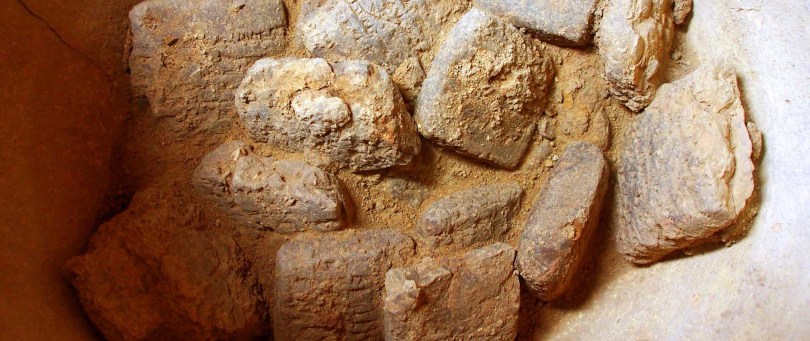
The Epic of Gilgamesh, often called the oldest piece of literature, is known to us only through a large collection of fragmentary tablets buried in the ground. Fortunately it was important enough to have been written down many times, but we still do not have a complete copy. Many of the fragments are of overlapping sections, and many sections have no fragment to witness them. More fragments continue to be found, and not infrequently. Though I cannot find the reference, I believe I once read or heard Andrew George, world expert on the Epic, saying that he believed we would eventually find enough tablets to piece together the entire thing.
Around the same time I had also watched a youtube video in which the host did a statistical analysis to predict how many giant species of giant sea creatures we have left to discover. It might feel impossible to predict how much you don’t know, but this is the miracle of statistics.
Here’s one way to look at it. Say you have the classic urn full of colored balls. You don’t know how many balls are in there, and you don’t know how many colors there are, either. But each time you reach into the urn and pull out a ball, you write the color down. (It doesn’t matter if you throw the ball back in.) If colors start repeating, then you can start estimating the fraction of balls that are that color. The more you draw, the more confident you can become. If you have any guess as to how many balls there are, then you can eventually converge on being confident about how many colors are in the urn.
Though we find the Epic of Gilgamesh in all these smashed up little bits, we do actually know fairly precisely how long the entire story is. (Sidenote: we’re talking about the Standard Babylonian Version here, and not the Old Babylonian Version, nor the Sumerian poems.) The Epic is eleven tablets long, and each tablet is a coherent part of the story, essentially like a modern chapter. Current published translations are about 100 pages. Tablets are not precisely standard sizes, but for copies of the Epic they’d be pretty close, and we often have enough of a chunk to understand how big the characters are relative to the tablet, and therefore how many lines are on the tablet.
So my scheme is that someone could create a chart that shows what fraction of the Epic we have discovered by each year. Then we just see if the line seems to be tapering off before we get to 100%. (This is somewhat different from the sea creatures/colored balls model above, but was similar enough to cause me to think of it.) I don’t actually know enough practical statistics to know which test one would run here, but I’m sure it’s pretty basic.
Difficulties
The first problem I envision with this project is that gathering the data might be a huge pain. Assyriology is not exactly cutting-edge with their data practices. I’m sure there are lots of standards for IDing tablet fragments, and denoting what lines they cover, their provenance, and so forth. But that might be a huge pain to sort through if you have no domain knowledge (or even if you do).
Another major difficulty here has to do with the distinction between discovery and translation. Cuneiform tablets sometimes preserve extremely well. And they were essentially the paperwork of ancient Mesopotamia. So what we find at archeological sites is more like the crushed filing cabinets and bookshelves of a ruined building. I imagine it might be like trying to understand 20th century America by sorting through the ruins of the World Trade Center towers.
All that is to say that while we have literally hundreds of thousands of tablets, most of them are extremely boring and uninformative, and we have oh so precious few people who can read them. And what this means for my proposed project here is that I don’t know to what degree the tablets have a recorded excavation date separate from a translation date. And it’s very unclear to me how it should be treated in the statistical analysis if a tablet was excavated in 1892, transliterated in 1923, translated by an Assyriologist in 1958, but then not published until 1999, as part of a giant posthumous publication of all his notes.
And one more factor might make this whole analysis pointless; people have started getting excited about the prospect of using AI to read and decode the remaining tablets with dramatically more speed.
 The Nameless Virtue