
This is my post for day 23 of the Inkhaven writing retreat.
Oracle bone script is considered the oldest known form of written Chinese. When you look at it, this makes sense; it looks more “primitive”, more pictorial, less unified in its stroke patterns. Bronze script, the next one, looks more like modern Chinese.
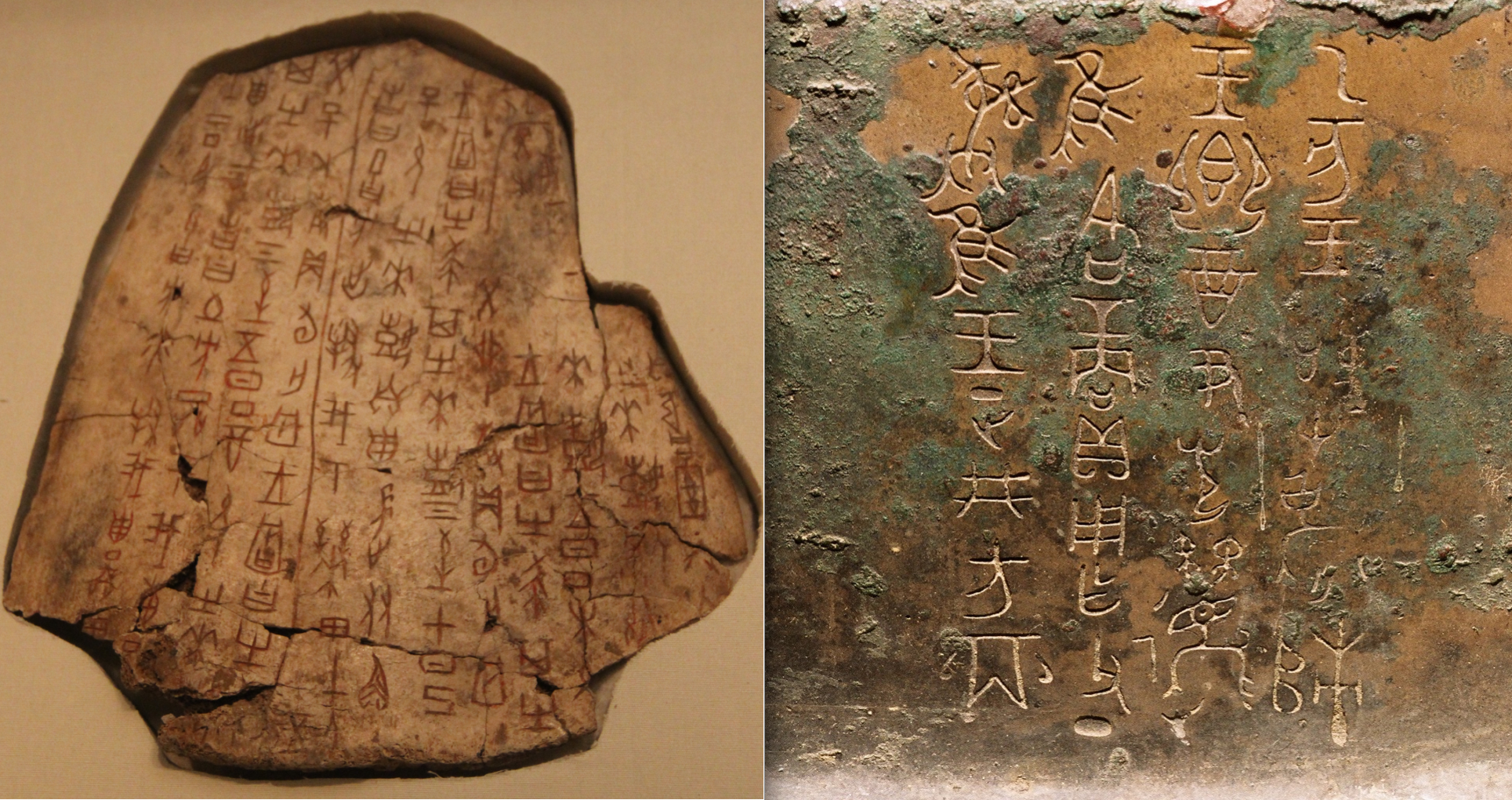
But hang on — oracle bone script is from 1250 BCE, and bronze script from 1200 BCE. Is fifty years really enough for a script to have evolved? In what way is oracle bone script meaningfully older?
I encountered this confusing pair of facts when first nerding out about the history of writing systems. I also mentioned it as an aside in my first Inkhaven post. For today’s post, I’m going to sit down and “livestream” my process of exploring this deeper. This means the flow and narrative of this post won’t be particularly crafted, but it will match what actually happens.
My motivation is to resolve my confusion about this particular fact, but I think that what you, the reader, should take away from this post is a detailed sense of what it’s like to do research on the modern internet. Trustworthiness is complicated, and getting answers takes a long time. The good news is that you have vast amounts of information available to you, so if you’re willing to stick with it, you can often figure out the answers to pretty niche questions.
Hypotheses
Before looking stuff up, I want to brainstorm some possibilities of how my confusion might resolve. All these ideas are just me thinking out loud; take nothing here as authoritative. Because I did read a lot about oracle bone script several months ago, my hypothesis generation below is influenced by whatever implicit knowledge I retained from then. This is also a recurring theme in research; you will have formed important but vague impressions during exploratory research, and you have to work with that when you try to nail things down later.
Okay, here are some hypotheses.
It could be that the 1250 BCE and 1200 BCE dates are representative of the oldest dated artifacts, but that historians have good reason to conclude that the two scripts have undocumented histories of different lengths. For example, maybe oracle bone script was first, but continued to be used long past the time that other forms of the script developed. This is highly precedented (postcedented?) — Egyptian hieroglyphs were calcified from a very early date, and stayed that way because it was considered the sacred form of writing. Other scripts developed alongside for practical purposes, and for smoother writing by ink.1 Written Sumerian was taught to students of cuneiform for hundreds of years after the spoken Sumerian fell out of use. Latin has the same story. Ye Olde English2 persists, especially via the influence of the KJV Bible and Shakespeare.
One possible contributing factor is that it’s harder to write by carving onto bone than other media of writing. So maybe oracle bone script stuck around for longer specifically for writing on the oracle bones.
It could be that linguists can tell that oracle bone script is older based on analyzing the etymology or shape changes of the characters. Writing systems are subject to evolutionary forces that have clear signatures. I’m not very familiar with the details, but I could find examples convincing.
It could be that some of the ancient documents explicitly say that oracle bone script is older than bronze script. This is a very unlikely hypothesis. From everything I’ve read, 100% of oracle bone script is written on oracle bones, which are all recording divination questions and results. I also believe that all of the early bronze script is on ceremonial bronze vessels, which just give names or very short inscriptions relevant to the vessel. Any ancient Chinese writing about the writing systems themselves would be (I’m guessing, but quite certain) hundreds of years older than these, and thus not particularly reliable.
Alternatively, it could be that historians are wrong.
This would be a pretty bold claim for me, a random enthusiast, to make, and I wouldn’t confidently make it without a lot more research. But part of developing an understanding of individual and collective knowledge finding processes is coming to realize just how unreliable the most reliable sources are.
History and archaeology in particular have an intense record of being confidently wrong. For a long time, the default belief was that the ruins in the Yucatan peninsula couldn’t have possibly been made by the ancestors of the native people. Top archaeologists would also do extremely dumb and destructive things, like using dynamite to excavate sites. People are systematically driven by things like status and preserving tradition. So the priors on expert consensus about oracle bone script versus bronze script just being wrong are not a rounding error.
There’s no question of the dating of the artifacts; they name kings whose reigns have known dates, and the bones have been radiocarbon dated.
Verifying the basic claims
I pulled the dates in the introduction from my head. I’d first like to triple-check them, and ideally get images of the oldest instances of the two scripts for comparison. I’d also like to find some examples of the claims that oracle bone script is older.
I’ll start by skimming through the wikipedia pages. Of course, I did this originally, but it’s fast and is a good way to find primary sources. I’ll go through them and paste relevant quotes below.
As a side note, when reading about Chinese history, the author will often reference the dynasty instead of giving a date range. The relevant ones for us here are the Shang (~1600 BCE – 1046 BCE) and the Zhou (1046 BCE – 771 BCE). The 1046 BCE date was the battle that cause the dynastic transition.
The wikipedia page for “Oracle bone script”
The info box says, “Period: c. 1250 – c. 1050 BC”.
The introduction says “Oracle bone script is the oldest attested form of written Chinese, dating to the late 2nd millennium BC.”
It then goes on to say, “The oracle bone inscriptions—along with several roughly contemporaneous bronzeware inscriptions using a different style—constitute the earliest corpus of Chinese writing, and are the direct ancestor of the Chinese family of scripts developed over the next three millennia.” This gives the citation “Boltz, William G. (1994). The Origin and Early Development of the Chinese Writing System”. Perhaps reading this book would simply answer my question, but we’ll keep going with a breadth-first search.
Later the page says, “It is generally agreed that the tradition of writing represented by oracle bone script existed prior to the first known examples, due to the attested script’s mature state. Many characters had already undergone extensive simplifications and linearizations, and techniques of semantic extension and phonetic loaning had also clearly been used by authors for some time, perhaps centuries.” That sounds useful to me, though I don’t know what many of those terms mean. It’s not clear to me whether this statement is evidence for or against oracle bone script representing an earlier form than bronze script.
Under the “Style” section, it says;3 “Along with the contemporary bronzeware script, the oracle bone script of the Late Shang period appears pictographic. The earliest oracle bone script appears even more so than examples from late in the period (thus some evolution did occur over the roughly 200-year period). Comparing the oracle bone script to both Shang and early Western Zhou period writing on bronzes, the oracle bone script is clearly greatly simplified, and rounded forms are often converted to rectilinear ones; this is thought to be due to the difficulty of engraving the bone’s hard surface, compared with the ease of writing them in the wet clay of the molds the bronzes were cast from.” That’s pretty confusing, because it makes it sound like oracle bone script is simplified from bronze script. I can easily imagine the causality going the other way, where bronze makers started smoothing out the sharp curves, given their easier medium. Overall the grammar of this paragraph manages to be impressively non-committal about the direction of causality. There is also a citation here; “Qiu Xigui (1988). Chinese Writing”. Perhaps reading this book would resolve the ambiguities.
The rest of the page continues to emphasize that oracle bone script was a full writing system, meaning that it had hundreds of years of evolution before the earlier artifact. The page also continues to cite the books by Boltz and Qiu several times.
The wikipedia page for “Chinese bronze inscriptions”
This page does not give a date range for the script above the fold. The first sentence does say (abbreviated) “Chinese bronze inscriptions … comprise Chinese writing made in several styles on ritual bronzes mainly during the Late Shang dynasty and Western Zhou dynasty”. So the date range is within the range of those dynasties, i.e. 1250 BCE – 771 BCE, but it doesn’t say how much within.
It’s also worth mentioning here that I’ve been saying “bronze script” as if it’s one thing, but as the quote above alludes to, “bronze script” refers to a category of scripts; we’re only interested in the earliest one. Bronzes with writing on them continued to be made (and preserved) up to the present day, whereas the oracle bone record stops relatively abruptly.
Continuing, the page’s introduction says, “The bronze inscriptions are one of the earliest scripts in the Chinese family of scripts, preceded by the oracle bone script.”
Later it says, “… bamboo books, which are believed to have been the main medium for writing in the Shang and Zhou dynasties. The very narrow, vertical bamboo slats of these books were not suitable for writing wide characters, and so a number of graphs were rotated 90 degrees; this style then carried over to the Shang and Zhou oracle bones and bronzes.” That sure sounds to me like the oracle bone script is not substantively older than the bronze script, and that they instead both came from the earlier bamboo-based script.
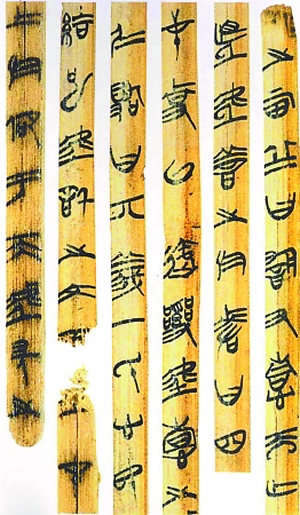
Then this page reiterates what we heard above; “The soft clay of the piece-molds used to produce the Shang to early Zhou bronzes was suitable for preserving most of the complexity of the brush-written characters on such books and other media, whereas the hard, bony surface of the oracle bones was difficult to engrave, spurring significant simplification and conversion to rectilinearity. Furthermore, some of the characters on the Shang bronzes may have been more complex than normal due to particularly conservative usage in this ritual medium…” This really sounds to me like oracle bone script is not older!
Other tertiary sources
Now that I’ve pulled all those non-committal and potentially conflicting quotes from wikipedia, the reader may be doubting my claim that oracle bone script is typically asserted to be older. To check that, I’ll just google various related terms, and tell you what some of the results say. I’ll also try to extract dates for the two scripts from the search results that seem remotely reputable (since wikipedia didn’t really give us a date for bronze script).
Okay, I did that search… and it was a pretty trash experience, epistemically speaking. One pattern I noticed is that sources were constantly conflating the dynasty range (whether Shang or “late Shang”) with the date range for the inscriptions.
Here are a few examples from sources with some degree of repute.
The Britannica article says that “The earliest known inscriptions” were the oracle bones. It also says “By 1400 BCE the script included some 2,500 to 3,000 characters”, which I think is not a date we have evidence for. It then says, “Later stages in the development of Chinese writing include the guwen…” which links to a page that sounds like “Guwen” is the bronze script.
This article on a popular Chinese language learning site claims that “The earliest Chinese characters were created using pictures or pictographs, which were originally inscribed on clay pottery and bone and then later on bronze and other metals.” and later “Bronze Writing evolved from Oracle Bone Script.” It does not mention bamboo writing.
This page from a Rutger’s professor seems to have pretty good SEO, because it was on the first page for multiple of my search terms. Reading down it, I see several yellow flags in the form of claims that contradict most of what I’ve read elsewhere. It also seems like said professor is primarily a chemist. He cites “Bronze writing” as 1400 BCE to 700 BCE, but also cites “Oracle-bone writing” as 1600 BCE 1100 BCE, which, again, I don’t think are evidenced dates.
This random page from the Harvard Art Museum says “Inscriptions cast into Shang bronze ritual vessels are among the earliest extant examples of Chinese writing.” and “Aside from bronze inscriptions, oracle bones … are the only other extant evidence of writing practice from the Shang dynasty.” This reads to me as not making a claim about which of the two are older.
Lastly, I recently went to the British museum, which had an oracle bone inscription on display. Here’s what the sign said;
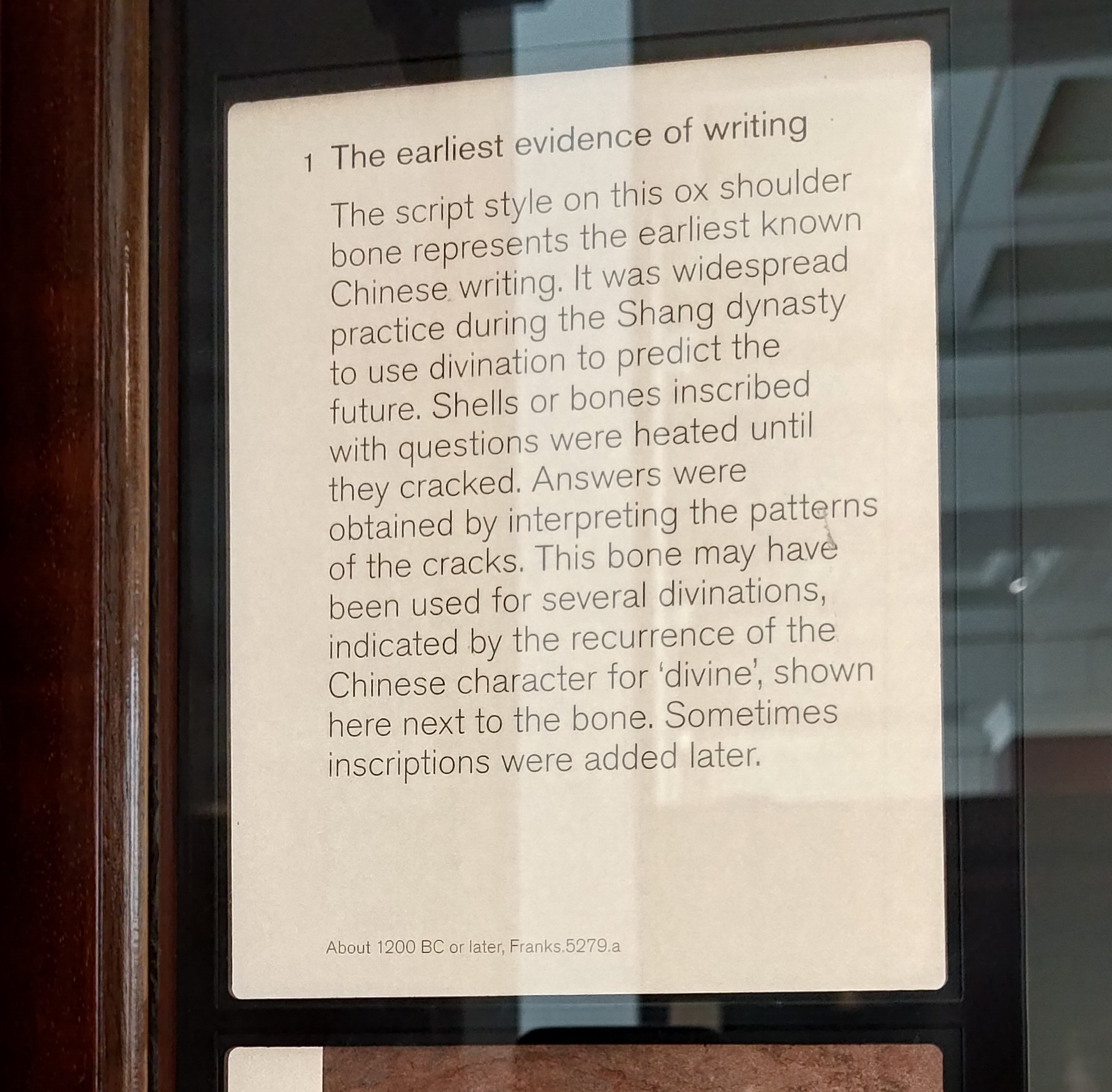
Again, no mention of bronze scripts.
I’m pretty weirded out by the fact that I have failed to find a specific date for the earliest bronze inscriptions. You would think that this would be a pretty clear question to get an answer to. The description on the cover of “A Source Book of Ancient Chinese Bronze Inscriptions (Cook & Goldin 2020)” says that it “…offers English translations and commentary on over eighty-two important bronze inscriptions, ranging in date from approximately 1200 B.C.E. to 200 C.E.” So that’s something, but I was unable to find a copy of this book.
From all this and other reading, it certainly sounds like bronze scripts are no earlier than the oracle bones.
Secondary sources
Now I’m going to try moving on to what I would call secondary sources. By this I mean academic books written by experts in the field.
The Ancestral Landscape (Keightley 2000)
In my past research, I’ve previously read the entirety of “The Ancestral Landscape: Time, Space, and Community in Late Shang China (ca. 1200–1045 B.C.)” by David N. Keightley. As far as I can tell, he is considered a reputable, and a leading (Western) researcher in the field.
Skimming through it again now, I realized that this book is mostly about what conclusions we can draw about the Shang people and culture using the oracle bone inscriptions as our source of information. It doesn’t talk that much about the development of the script, though it does talk a fair bit about the script itself. Unfortunately the word “bronze” does not appear in the index.
Does Keightley claim that oracle bone script is the oldest? Here’s a sentence I found in the preface; “These records, the earliest body of writing yet found in East Asia, were produced in the following way.” That actually sounds fair to me. Claiming that the oracle bones are the earliest body of writing is much different than claiming that bronze script descended from oracle bone script. I haven’t quite figured out how big the corpus of (late Shang) bronze script is yet, but it sounds plausibly small enough not to constitute a “body”.
Chinese Writing (Qiu 2000)
Now let’s check out one of the books heavily citied by the two wikipedia articles. https://starlingdb.org/Texts/Students/Qiu%20Xigui/Chinese%20Writing%20%282000%29.pdf This book is a 2000 English translation of the 1988 Chinese original. The preface makes it sound like it’s also been quite updated, so perhaps we can consider the information to be up to date circa 2000.
From the table of contents, there could be a lot of relevant sections, but it does not seem to contain the words “oracle” or “bronze”. (This PDF is not OCR’d so I can’t use the find function.) The index contains several page numbers for both scripts (which tend to have overlapping ranges). From reading through all these pages, it sounds to me like Qiu treats the two scrips as on-par with each other.
From page 29; “The earliest relatively substantial examples of ancient Chinese writing discovered so far are the bone and bronze inscriptions of the late Shang dynasty.”
From page 63; “It should be pointed out first that in terms of their structure, bone and bronze graphs exhibit different characteristics. During the Shang period the writing brush was the primary writing implement in use. … Graphs appearing on bronzes retain the features of brush-written characters, whereas those written on bone do not. As the Shang rulers frequently made divinations, the number of divinatory notations that had to be inscribed on bones was quite large. Inscribing characters on a medium as hard as bone is a time-consuming and strenuous task. For the sake of efficiency, engravers out of necessity altered the forms of the brush-written characters… Bone script can be viewed as a rather peculiar form of the popular script of that era, whereas the bronze script of that period for the most part may be viewed as a formal script.”
So without going deeper and reading the whole book, my judgement is that this source does not support the idea the oracle bone script precedes bronze script, and instead supports the idea that they were contemporary scripts adapted to their function and medium.
Overall, this book seems extremely reasonable and balanced.
The Origin and Early Development of the Chinese Writing System (Boltz 1994)
Reading through the index, it says almost nothing about bronzes. It seems to mostly be an academic defense against the (then) popular idea that Chinese was pictographic. I now realize that while this book was heavily cited by the wikipedia page for oracle bone script, it was not cited on the page for Chinese bronze inscriptions. Oops! It does not seem to make a strong claim about oracle bone script in particular being the predecessor of all other Chinese scripts.
Conclusion
My conclusion is that oracle bone script is not a predecessor to bronze script. Instead, they both existed at the same time as each other and as a more common script that has not survived due to being written on perishable materials like bamboo.
However, my conclusion is also not that “historians were wrong” — it’s that all the tertiary sources are wrong. This should have been an obvious hypothesis, but I failed to think of it.
So what happened? Why does everyone say oracle bone script is the older predecessor? I think there are several contributing factors.
- Oracle bone script “feels” older. Both because it looks more primitive and because bones feel older than bronze.
- It may be that technically, the oldest known date for an oracle bone inscription is slightly older than the oldest known date for a bronze inscription.
- The dates of all the known oracle bones are tightly clustered in the 200 year range which also happens to be the beginning of the date range for bronze inscriptions. Since oracle bone script “died out” much earlier than the bronze script, that kinda makes it feel older.
- Scholarship in early Chinese writing is niche, and mostly not translated into English.
Though this post is very long, it was only one day of research, and again, I am by no means an expert! So if you are, or happen to know key facts I missed, please let me know!
And if you’re a random bystander who’s considering going into research; hopefully this little adventure helped you decide. I honestly enjoyed it a lot.
- An Egyptologist will tell you that hieroglyphs changed a ton over the millennia of use; this is true, but we’re talking about differences of a different magnitude. ↩︎
- Actually Early Modern English. Old English is what Beowulf was written in, and is totally unreadable to a modern English reader. ↩︎
- Throughout this post, all emphasis in quotes is mine. ↩︎
 The Nameless Virtue
I think you’ve badly misread the Wikipedia sources. For example:
This proceeds from the unstated assumption that (0) all scripts start complex, usually pictographic in the earliest forms, and become simplified with use. (I understand this to be generally very solid as an assumption.) If the bronze script (1) looks similar but (2) the bone script is more simplified, they therefore (1) share heritage, but (2) the bone script is older because it had time to simplify.
(4) is supported by this quote, (3) is not. The bamboo is old and samples did not survive, but we can tell it was an ancestor of both scripts that did because of the shared heritage and rotation of graphs.
This is providing an alternate hypothesis that contrasts with (0) and could explain the differential simplification without differential age, but it’s the only thing here that supports that.
On some of the other sources:
That’s dates his research published in a collected volume, his part here; I understand that to be more prestigious than papers in history, but I have no idea how you distinguish the equivalent of junk journals. His argument looks plausible but motivated, but that argument also claims 2100; the more restricted case for 1600 via fossilized names seems likely mostly true.
The dates we have are the dynasty dates because all we know is when the capital site where they were found was in use. Oracle bones we have a little carbon dating, which established the Shang era’s years, but not much; bronze we can’t get that.
LikeLike