This is my post for day 29 of the Inkhaven writing retreat.
Here is an idea for a research project I would do if I had infinite time.
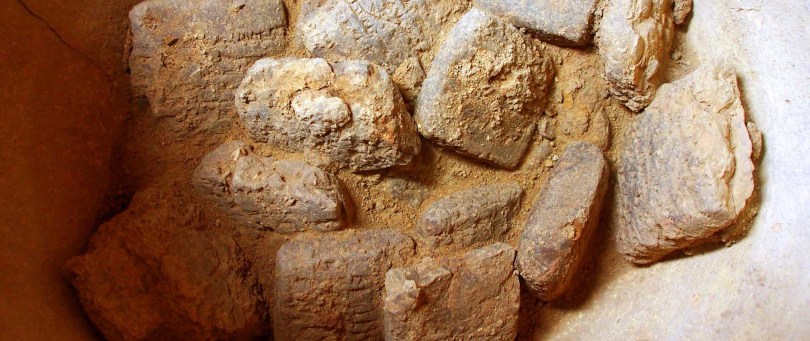
The Epic of Gilgamesh, often called the oldest piece of literature, is known to us only through a large collection of fragmentary tablets buried in the ground. Fortunately it was important enough to have been written down many times, but we still do not have a complete copy. Many of the fragments are of overlapping sections, and many sections have no fragment to witness them. More fragments continue to be found, and not infrequently. Though I cannot find the reference, I believe I once read or heard Andrew George, world expert on the Epic, saying that he believed we would eventually find enough tablets to piece together the entire thing.
Around the same time I had also watched a youtube video in which the host did a statistical analysis to predict how many giant species of giant sea creatures we have left to discover. It might feel impossible to predict how much you don’t know, but this is the miracle of statistics.
Here’s one way to look at it. Say you have the classic urn full of colored balls. You don’t know how many balls are in there, and you don’t know how many colors there are, either. But each time you reach into the urn and pull out a ball, you write the color down. (It doesn’t matter if you throw the ball back in.) If colors start repeating, then you can start estimating the fraction of balls that are that color. The more you draw, the more confident you can become. If you have any guess as to how many balls there are, then you can eventually converge on being confident about how many colors are in the urn.
Though we find the Epic of Gilgamesh in all these smashed up little bits, we do actually know fairly precisely how long the entire story is. (Sidenote: we’re talking about the Standard Babylonian Version here, and not the Old Babylonian Version, nor the Sumerian poems.) The Epic is eleven tablets long, and each tablet is a coherent part of the story, essentially like a modern chapter. Current published translations are about 100 pages. Tablets are not precisely standard sizes, but for copies of the Epic they’d be pretty close, and we often have enough of a chunk to understand how big the characters are relative to the tablet, and therefore how many lines are on the tablet.
So my scheme is that someone could create a chart that shows what fraction of the Epic we have discovered by each year. Then we just see if the line seems to be tapering off before we get to 100%. (This is somewhat different from the sea creatures/colored balls model above, but was similar enough to cause me to think of it.) I don’t actually know enough practical statistics to know which test one would run here, but I’m sure it’s pretty basic.
Difficulties
The first problem I envision with this project is that gathering the data might be a huge pain. Assyriology is not exactly cutting-edge with their data practices. I’m sure there are lots of standards for IDing tablet fragments, and denoting what lines they cover, their provenance, and so forth. But that might be a huge pain to sort through if you have no domain knowledge (or even if you do).
Another major difficulty here has to do with the distinction between discovery and translation. Cuneiform tablets sometimes preserve extremely well. And they were essentially the paperwork of ancient Mesopotamia. So what we find at archeological sites is more like the crushed filing cabinets and bookshelves of a ruined building. I imagine it might be like trying to understand 20th century America by sorting through the ruins of the World Trade Center towers.
All that is to say that while we have literally hundreds of thousands of tablets, most of them are extremely boring and uninformative, and we have oh so precious few people who can read them. And what this means for my proposed project here is that I don’t know to what degree the tablets have a recorded excavation date separate from a translation date. And it’s very unclear to me how it should be treated in the statistical analysis if a tablet was excavated in 1892, transliterated in 1923, translated by an Assyriologist in 1958, but then not published until 1999, as part of a giant posthumous publication of all his notes.
And one more factor might make this whole analysis pointless; people have started getting excited about the prospect of using AI to read and decode the remaining tablets with dramatically more speed.
This is my post for day 28 of the Inkhaven writing retreat.
Learning a language is notoriously difficult. You have to learn a thousand things before you can hold even a basic conversation at the grocery store. The gap is huge.
It’s widely recognized that children have some kind of biological advantage in learning their first language (in addition to the fact that it’s mandatory and also they have all the time in the world). But you don’t stop learning your native language as a child. You constantly learn new slang, new fancy words, and different patterns become more clear to you over time. You might learn different registers like writing office emails, academic papers, or spending time in a new group of friends with a different culture. And as the decades start to pass, you can experience even the baseline rules of your native language shift. It’s easier to keep up with these, since you’re just shifting incrementally.
But… all language diversity occurred through incremental shifting over time. Just, a lot of time. So what if you could learn a language just by… learning those shifts backwards?
Start by watching old black & white movies. Right away you’ll see plenty of differences (and not just the transatlantic accent.) These probably already feel familiar to you.
Then start reading some older novels or newpaper articles. Give some Charles Dickens a try. Whenever you encounter something you don’t understand, look it up so that you’re maintaining intelligibility. As you go further back you’ll notice longer sentences. I think this was just a stylistic fad, and you can learn to parse them faster by decided that many of the commas and semicolons are basically periods, where you can give your mind a break. Eventually you can get back to writing like the Federalist papers or George Washington’s farewell address.
We might have been starting too slow. This was the easy part, and we have a long way to go. So make sure it’s not too long before you can easily read Shakespeare. There might be a lot to look up, but there are lots of resources. Once that’s easy, the Canterbury tales might be more approachable. You’ll often find these “translated” into modern English, but we obviously want the original.
This is about to get a lot harder, so let’s take a breath with a recreational read. The Wake by Paul Kingsnorth is a modern novel written in a made up dialect of English that is made to sound as much like old English as possible while still being readable to a modern speaker.
when i woc in the mergen all was blaec though the night had gan and all would be blaec after and for all time
It takes a bit to get the engine started, but I found it extremely satisfying when I got to the point where I didn’t notice it anymore. If you want even more fun you can join the Anglish-speaking community.
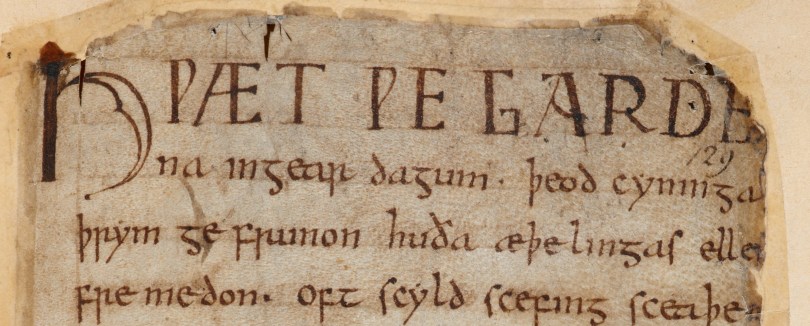
But after that, we gotta get serious and learn real Old English. Very recently a book has been released that is designed precisely to teach you Old English with a story that gets gradually more complex. It’s called Ōsweald Bera, and yes, it’s about a bear named Ōsweald.
After that, you can read Beowulf. Just kidding, that would still be way too hard. But you’d be much closer. And, wait, weren’t we trying to get to some other language? Okay, so it would take quite a lot more steps to get down the ancestral tree of languages before you could then start tracing a branch back up to a currently-spoken language. And if you don’t want that language to be Frisian, you’ll need to go even further back. So maybe this scheme is as silly as we expected. But at least along the way you got a degree in the history of the English language.
This is my post for day 27 of the Inkhaven writing retreat.
I grew up just about at pace with the rise of the internet, laptops, and smart phones. It was fast enough that I could tell it was revolutionary, but slow enough for me to stay up to date. Along the way, I saw lots of adults and older people totally fail to keep up. Or, I shouldn’t say “fail”, because they weren’t always trying. And for many of these people, that was totally the right call. But for many others it wasn’t, and their lives started to get worse. Sometimes it just got worse relative to if they had adopted the changes, but other times it got worse in the absolute. Eventually your bank or your pharmacy starts requiring you have an email address, or the ability to receive texts, etc. If you don’t understand things like good passwords, or that some email addresses are “noreply@”, then you’re going to eventually have problems. If you don’t keep up with what’s normal, then the scammers can get you pretty quickly.
So at some point in my youth I realized that this was a natural progression people went through as they aged, and that if I didn’t want this to happen to me, I would need to instill certain habits and tendencies in myself. I realized that if I started thinking that what “the kids these days” were doing was weird or useless, that might be what it feels like to be missing the train to the future.
Of course, there are plenty of things that the kids do that are weird or useless, or sometimes even harmful. And sometimes there are things that all of society does that are harmful. So my policy was not just to “try everything once”. Here are two similar examples for contrast.
At some point a lot of my friends started using a chat platform called Discord. It looked like it was basically Slack, but for gaming? Or at least developed for and adopted by the gaming community. At first there was no benefit to me switching, since I could still talk to all my friends by other means. Over time more and more people dropped off facebook. Some content creators I follow started hosting Discord servers for supporters. Eventually, I started going to events that coordinated over Discord, and then I really needed to learn how to use it. At this point, I run two servers, a personal one and one for my research fellows. I still feel like I’m not totally on-boarded, and I struggle to understand how to casually participate in bigger servers with infinite messages. But at least I’m here.
In contrast, I have never downloaded TikTok. This type of content consumption just feels insane to me. Like, I get it, I have enough exposure to pop culture that I’ve seen several of the emergent sub-communities that TikTok made possible. The amount of creativity in the format is really beautiful to watch. But like… it is just straight-forwardly the heroin of social media apps? There’s no way I’m touching that. It’s also wild to me that people are fully content if not thrilled to have their experience fully controlled by the app. I want to watch the videos that I decide to watch. And when a video is done I want to be the one who decides whether I watch another one. I also want to know how long it is, and the date it was uploaded, and who the creator is, et cetera. The fact that all shortform platforms seem to aggressively hide this information is so bewildering to me.
Okay, rant over — the point is that I think I can assess from an outside view that my disinterest in Discord needed to be overcome but that my disinterest in TikTok was the correct call.
A more general trend that makes these calls harder is what Cory Doctorow termed “enshittification“. This is the trend of software updates slowly adding “features” or other changes that eventually turn the service into, well, shit. This starts to happen after everybody is dependent on the infrastructure, and it’s not necessarily the result of individuals being evil. It can be viewed through the lens of incentive gradients and evolution dynamics. I’ve been on facebook almost since it began. And for the first several years, I kinda hated every update they pushed, but then eventually loved the change. The initial hatred was the old-man dynamic. There was a golden age where the software was mature, richly featured, and the platform teeming with life. But these days, I don’t think I have you tell you that facebook has objectively enshittified.
Sometimes it’s harder to tell. My first couple of laptops had replaceable batteries. That is, there was a compartment that you could unscrew or unclip to access the battery. Once the battery’s lifespan got too short, you could buy a replacement on Amazon and swap it out yourself. This was amazing and I loved it. I would keep a spare battery to take when I traveled. Eventually, fewer and fewer models had this feature. There was probably some kind of enshittification factor at play, where companies figured out that few enough buyers cared enough about this feature, and that they would make more money by not letting you replace the battery. But also, batteries got better. They started lasting longer. External power banks got better, and everything started using the same USB-C standard, which was faster and more convenient. I haven’t replaced a battery in many years, and also I haven’t wanted to.
I’m currently struggling real hard to keep away from being an old man about AI. I mean, I do think its an existential risk and we should shut it all down. But separately, as an everyday tech product, I should obviously be making use of it and keeping up with the developments. I’m finding it mysteriously hard to figure out what it’s good for, but I keep trying, at the endorsed rate.
This is my post for day 26 of the Inkhaven writing retreat.
Okay, so you might just know the answer to this one. If so, I think it could still be fun to imagine you don’t, and play along.
I was once chatting with a friend who knew a lot about biology. I don’t remember what we were talking about, but perhaps it was things like endocrine glands, which are just little organ blobs who are responsible for making hormones.
And I remember wondering out loud to her, “oh, yeah, …and where is blood made? Presumably there’s just some organ whose job it is to make blood? I feel like I would have heard of it…” and she responded, “Oh, you didn’t know? Blood is made in the bones.”
And then my brain exploded with incredulity and objections (and also fascination and wonder, because I immediately believed her).1 I was like, WHAT? Made in the WHERE? Why???
It’s crazy that the main structural component of your body would be doing something else. It’s like if the steel beams of a building just so happened to also make good solar panels. Like, no, evolution, what are you doing. Separate things should do separate things. Bones do a great job holding me up. Their existence is justified.
Where does the blood come out?? It’s not like there are little holes at the end of the bones where the blood vessels are attached? Like… does it come out the sides, or the ends, or …???
Bones are all totally different shapes! And there are so many bones. Do your hips make blood? Your vertebrae? Your tiny foot bones? Your skull? Your teeth? Your ear bones??? This is just ridiculous.
What happens when you break a bone??? That seems like a big problem. I mean I guess it’s not necessarily a bigger problem than if your blood was made in a single squishy blog inside your chest. But it still seems like a problem. If you break a bone real bad, does it just start… leaking blood? (In addition to the, erm, other blood you’d be losing.)
If you lose a limb, I guess you just make less blood? Which seems… fine I guess? Especially since you have one less limb that needs blood. But still weird.
Birds have super thin tiny bones. Do they just have less blood?
Oh, but maybe bone-making bloods are a mammal thing? I mean that would be wild, but this whole situation is wild. Biology is lawless.
Wait, there are tons of animals that don’t have any bones! Worms? Slugs? Insects have exoskeletons… next are you going to tell me that insect shells make blood? What about an octopus?
I think my friend must have put on a big grin and thought “this is going to be a fun time“. Because, it is true that blood is made in the bones, so all of these questions have answers. Some of them she knew, and some of them we had to look up. And exploring the world together is one of the best activity to do with someone like me.
And also, somewhere in the back of my mind, there was a little note of familiarity, of recognition. It went “oh, that feels familiar… something about bone marrow?” The skill of noticing that little feeling is part of what it means to be a rationalist, to be trying as hard you can to see the world as it is. ↩︎
This is my post for day 25 of the Inkhaven writing retreat.
In a previous post, I described the state of what I called “being a policy”. I contrasted this with habits, heuristics, and plain old conscious deciding. I think a reasonable response to this would be, why would one want to “be a policy”? Isn’t it better to just always be flexibly able to update your decision process to account for new information, et cetera?
Here are some reasons I know of for wanting to be a policy.
Disclaimer: none of what I’m saying here is novel, and all of it has been written about voluminously by others elsewhere, from Aristotle to Wei Dai.
It’s fast
The first reason is that it’s costly or impractical or impossible to calculate out the best action to take in all circumstances. Policies may be hard to follow in the motivation sense, but they are easy to follow in the cognitive sense. However, this reason is shared by habits and heuristics, and doesn’t justify why you’d want to install a policy instead.
To counter other biases
Our minds contain some built-in parts of the architecture that cannot be changed, at least not easily. If these parts influence us to take actions that are systematically working against our values, then we may be able to install a policy to counteract them.
For example, perhaps you’re addicted to checking your phone in the morning. If you leave the phone next to your bed, you will check it. So to counter this you set a policy of leaving your phone outside the room overnight.
A company might use a policy to counter implicit bias. If they’re hiring for a position where most candidates are men, they might require interviewing at least one woman before giving someone an offer.
To be reliably cooperative
There are endless situations where two interacting people would each be better off if they could cooperate on their actions, but where one party defecting leaves the cooperating party worse off (as encapsulated by the prisoner’s dilemma). Being a policy means you can’t change your actions to differ in specific circumstances. So if the policies could somehow know for sure that each other ran the appropriate policy, they could reliably cooperate, leading to better outcomes for everyone.
Unfortunately people cannot literally read each other’s brain states. But due to historical contingencies of evolution, people can discern with some degree of reliability whether other people are running certain policies. Or, to say that in a normal way, you can just kinda tell that Jane is an honest person. Lots of little signals like facial expressions, reaction times, and a consistent history of honesty can provide pretty good evidence of when someone is running honesty as a policy and not just re-deciding to tell the truth every time.
Terminally valuing being a policy
Last but not least: some people want to be a policy because they value that state in and of itself. Some people work hard because they like the results of their work, some people work hard because they want other people to think they’re a hard worker, and some people work hard because they like being a hard worker, period. I personally value having true beliefs, not because they’re useful for my other goals, not because it makes me more useful for other people, but because I value being a thing that has true beliefs. Those other benefits are huge, but they are in addition to my terminal value of having true beliefs. I do have other beliefs, and it is hypothetically possible that they will come in conflict one day such that I would prefer to have false beliefs. But I’m not even sure if I could choose that, because I’ve been running this other policy for so long.
This is my post for day 24 of the Inkhaven writing retreat.
Imagine you’re in the ancestral environment. (People do that, right? That’s normal?) The only thing you know about the shape of the world is what you’ve seen with your own eyes. You and your tribe have roamed around quite a bit, so you’ve seen meadows, rivers, and mountains, and you know the earth can change a lot. But there’s always a horizon. If you actually sat down on a log and thought about it, what would the options be?
I feel like I’ve heard a lot of cultural myths about the sky. About what would happen if you somehow went up and up and up. About how the gods live there or whatever. It also seems pretty common for people to interpret the sky as a dome. Thinking of it as a dome gives you some sense that the edges might be walls or barriers of some kind, and I guess that might lead you to think of the surface of the earth as a disk of a fixed size.
Presumably one reason people think of the sky as a dome is because they can see the stars rotate smoothly. And, of course, they rotate smoothly because the earth is a sphere rotating in space, and the stars are approximately fixed and infinitely far away.
But does this actually look different than if the earth was flat, and the stars infinitely far away, and rotating around the north star? This is kind of hard to intuit, but my sense is that it would actually look the same. So why does it look so much like a dome?
Oh, right — the sun and the moon also seem to travel on the dome. Since you can see their diameter, you can tell they’re not infinitely far away, and so if they were traveling in straight lines, you’ll see them get smaller on the horizon. So maybe the sun and moon are the main reason people thought of the sky as a dome.
Let’s put that aside, and assume we have no reason to think the sky is a dome. What would people think about the horizon? If you keep walking for days on end, and new, random landscapes keep coming over the horizon, I feel like it would be very reasonable to assume that it just went on forever. (The oceans are compelling evidence for an end, but if land can suddenly turn into ocean then it stands to reason that ocean can suddenly turn into land.) And as you walked around, you would occasionally find more people. And the more you walked the more people you would find. I think it would be reasonable to conclude that the earth is filled with infinitely many people!
As a small digression, some people think that Occam’s razor means that each postulated physical object requires evidence; that the burden grows with the number of objects. They would say that, maybe seeing a few trees is evidence for a few more unseen trees, or that seeing a thousand stars is evidence for around a thousand more unseen stars, but surely infinitely many trees or stars is infinitely unlikely.
I think this is reasonable but wrong. Nature is not out there manufacturing new objects one at a time, using up some kind of finite resources, like you or I would be. Nature just is a way. And being the way of “filled with thirty trees” is not tremendously more likely than being the way of “filled with endless trees”. My formal stance on this is based on descriptive complexity; longer description length means lower probability. Since you can formally well-define “infinity” with a very small number of logical symbols, that to me makes it actually quite likely. In contrast, most specific finite numbers take a long time to describe. So the more objects you see, the more likely there are to be infinitely many.
Going back to the question of how many people there are, can you imagine how crazy the world would feel if you believed there were infinitely many people? I have grown up always knowing that the earth was finite and so were its people. It’s obviously huge and detailed, but in some sense, there’s a comprehensible limit. You can look at globes and see all the continents. You can start to memorize the names of countries, and the layout of the largest cities. But if an infinite earth was roughly evenly populated forever and ever, you would never know what might be about to come over the horizon. You could find a utopian city of gold, or a nest of dragons. If some army or plague was spreading across the land, you would just not be able to do anything about it. Presumably this is in fact how many people felt throughout history, or still feel.
There’s one more direction we could speculate about; down. This seems to be far less popular. But like, really truly, if you knew nothing about physics or the nature of matter, and all you had was a few decades of experience running around on the earth — what would you think was down there? What would you expect to happen if you just… started digging?
The sky has the really weird property that you can see right through it. And it kind of seems easier to go up. You can throw stuff pretty high. You can go climb a mountain. You can see that birds and clouds got up there somehow. But the ground is way more unforgiving, if you try to go down. Holes collapse pretty easily, so you’d have to dig out a huge cone.
I think it would be reasonable to believe that it’s just dirt and rock for miles and miles, way more than you could ever practically dig. But there would still be a fact of the matter about what’s below that. Would you believe in infinite rock? Would you believe that space itself stops? Sure, you could believe in hell, but hell has a floor. What’s under the floor? One has to wonder what a Solomonoff inductor predicts.
I’d love to read speculative fiction where some prehistoric rationalists use their spare resources to pursue a deep understanding of the universe by digging a really deep hole. And where, in that universe, the earth is an infinite flat plane, and the answer to what lies below is not the same as in our world.
This is my post for day 23 of the Inkhaven writing retreat.
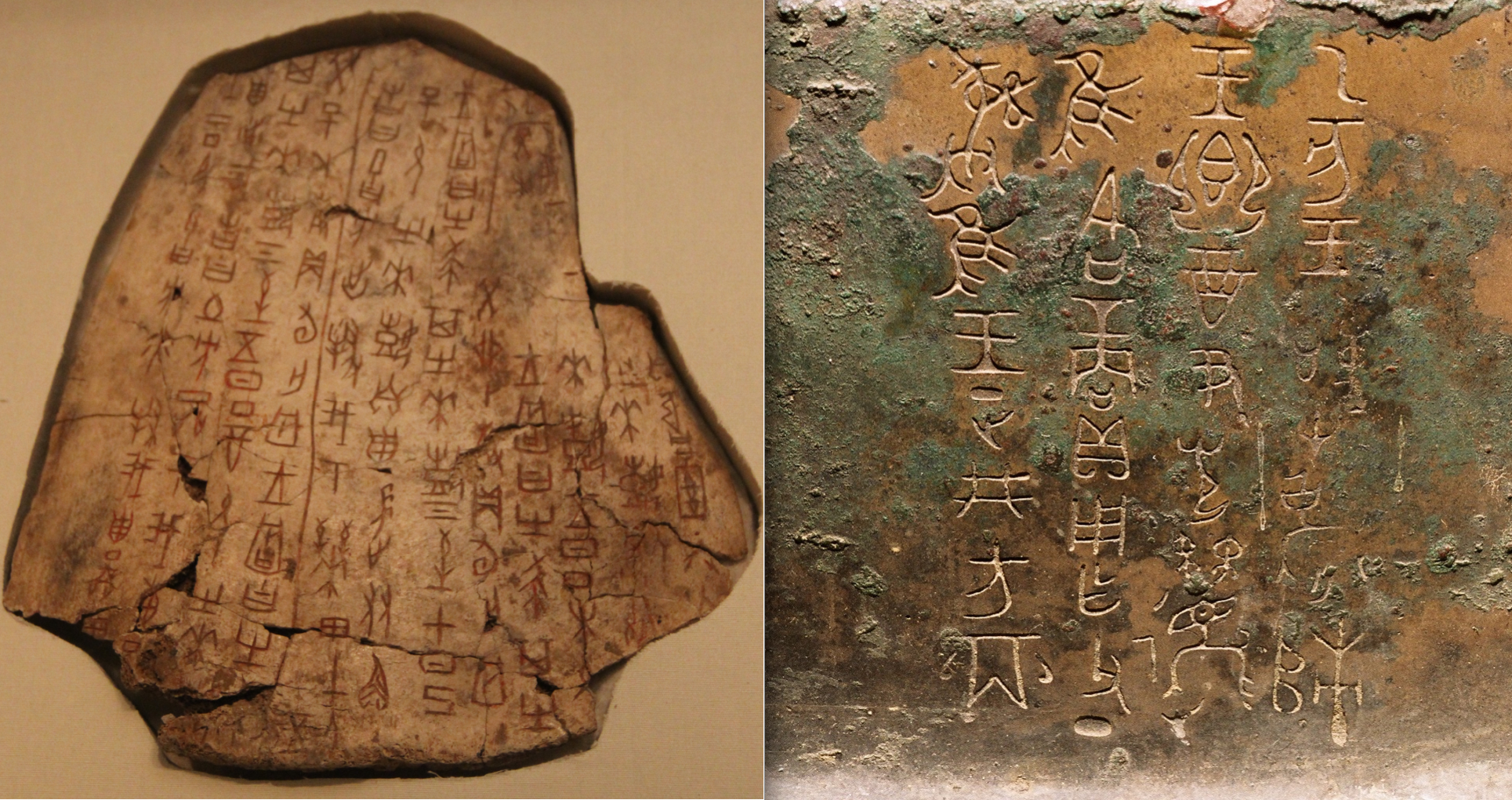
Oracle bone script is considered the oldest known form of written Chinese. When you look at it, this makes sense; it looks more “primitive”, more pictorial, less unified in its stroke patterns. Bronze script, the next one, looks more like modern Chinese.
But hang on — oracle bone script is from 1250 BCE, and bronze script from 1200 BCE. Is fifty years really enough for a script to have evolved? In what way is oracle bone script meaningfully older?
I encountered this confusing pair of facts when first nerding out about the history of writing systems. I also mentioned it as an aside in my first Inkhaven post. For today’s post, I’m going to sit down and “livestream” my process of exploring this deeper. This means the flow and narrative of this post won’t be particularly crafted, but it will match what actually happens.
My motivation is to resolve my confusion about this particular fact, but I think that what you, the reader, should take away from this post is a detailed sense of what it’s like to do research on the modern internet. Trustworthiness is complicated, and getting answers takes a long time. The good news is that you have vast amounts of information available to you, so if you’re willing to stick with it, you can often figure out the answers to pretty niche questions.
Hypotheses
Before looking stuff up, I want to brainstorm some possibilities of how my confusion might resolve. All these ideas are just me thinking out loud; take nothing here as authoritative. Because I did read a lot about oracle bone script several months ago, my hypothesis generation below is influenced by whatever implicit knowledge I retained from then. This is also a recurring theme in research; you will have formed important but vague impressions during exploratory research, and you have to work with that when you try to nail things down later.
Okay, here are some hypotheses.
It could be that the 1250 BCE and 1200 BCE dates are representative of the oldest dated artifacts, but that historians have good reason to conclude that the two scripts have undocumented histories of different lengths. For example, maybe oracle bone script was first, but continued to be used long past the time that other forms of the script developed. This is highly precedented (postcedented?) — Egyptian hieroglyphs were calcified from a very early date, and stayed that way because it was considered the sacred form of writing. Otherscripts developed alongside for practical purposes, and for smoother writing by ink.1 Written Sumerian was taught to students of cuneiform for hundreds of years after the spoken Sumerian fell out of use. Latin has the same story. Ye Olde English2 persists, especially via the influence of the KJV Bible and Shakespeare.
One possible contributing factor is that it’s harder to write by carving onto bone than other media of writing. So maybe oracle bone script stuck around for longer specifically for writing on the oracle bones.
It could be that linguists can tell that oracle bone script is older based on analyzing the etymology or shape changes of the characters. Writing systems are subject to evolutionary forces that have clear signatures. I’m not very familiar with the details, but I could find examples convincing.
It could be that some of the ancient documents explicitly say that oracle bone script is older than bronze script. This is a very unlikely hypothesis. From everything I’ve read, 100% of oracle bone script is written on oracle bones, which are all recording divination questions and results. I also believe that all of the early bronze script is on ceremonial bronze vessels, which just give names or very short inscriptions relevant to the vessel. Any ancient Chinese writing about the writing systems themselves would be (I’m guessing, but quite certain) hundreds of years older than these, and thus not particularly reliable.
Alternatively, it could be that historians are wrong.
This would be a pretty bold claim for me, a random enthusiast, to make, and I wouldn’t confidently make it without a lot more research. But part of developing an understanding of individual and collective knowledge finding processes is coming to realize just how unreliable the most reliable sources are.
History and archaeology in particular have an intense record of being confidently wrong. For a long time, the default belief was that the ruins in the Yucatan peninsula couldn’t have possibly been made by the ancestors of the native people. Top archaeologists would also do extremely dumb and destructive things, like using dynamite to excavate sites. People are systematically driven by things like status and preserving tradition. So the priors on expert consensus about oracle bone script versus bronze script just being wrong are not a rounding error.
There’s no question of the dating of the artifacts; they name kings whose reigns have known dates, and the bones have been radiocarbon dated.
Verifying the basic claims
I pulled the dates in the introduction from my head. I’d first like to triple-check them, and ideally get images of the oldest instances of the two scripts for comparison. I’d also like to find some examples of the claims that oracle bone script is older.
I’ll start by skimming through the wikipedia pages. Of course, I did this originally, but it’s fast and is a good way to find primary sources. I’ll go through them and paste relevant quotes below.
As a side note, when reading about Chinese history, the author will often reference the dynasty instead of giving a date range. The relevant ones for us here are the Shang (~1600 BCE – 1046 BCE) and the Zhou (1046 BCE – 771 BCE). The 1046 BCE date was the battle that cause the dynastic transition.
The wikipedia page for “Oracle bone script”
The info box says, “Period: c. 1250 – c. 1050 BC”.
The introduction says “Oracle bone script is the oldest attested form of written Chinese, dating to the late 2nd millennium BC.”
It then goes on to say, “The oracle bone inscriptions—along with several roughly contemporaneous bronzeware inscriptions using a different style—constitute the earliest corpus of Chinese writing, and are the direct ancestor of the Chinese family of scripts developed over the next three millennia.” This gives the citation “Boltz, William G. (1994). The Origin and Early Development of the Chinese Writing System”. Perhaps reading this book would simply answer my question, but we’ll keep going with a breadth-first search.
Later the page says, “It is generally agreed that the tradition of writing represented by oracle bone script existed prior to the first known examples, due to the attested script’s mature state. Many characters had already undergone extensive simplifications and linearizations, and techniques of semantic extension and phonetic loaning had also clearly been used by authors for some time, perhaps centuries.” That sounds useful to me, though I don’t know what many of those terms mean. It’s not clear to me whether this statement is evidence for or against oracle bone script representing an earlier form than bronze script.
Under the “Style” section, it says;3 “Along with the contemporary bronzeware script, the oracle bone script of the Late Shang period appears pictographic. The earliest oracle bone script appears even more so than examples from late in the period (thus some evolution did occur over the roughly 200-year period). Comparing the oracle bone script to both Shang and early Western Zhou period writing on bronzes, the oracle bone script is clearly greatly simplified, and rounded forms are often converted to rectilinear ones; this is thought to be due to the difficulty of engraving the bone’s hard surface, compared with the ease of writing them in the wet clay of the molds the bronzes were cast from.” That’s pretty confusing, because it makes it sound like oracle bone script is simplified from bronze script. I can easily imagine the causality going the other way, where bronze makers started smoothing out the sharp curves, given their easier medium. Overall the grammar of this paragraph manages to be impressively non-committal about the direction of causality. There is also a citation here; “Qiu Xigui (1988). Chinese Writing”. Perhaps reading this book would resolve the ambiguities.
The rest of the page continues to emphasize that oracle bone script was a full writing system, meaning that it had hundreds of years of evolution before the earlier artifact. The page also continues to cite the books by Boltz and Qiu several times.
The wikipedia page for “Chinese bronze inscriptions”
This page does not give a date range for the script above the fold. The first sentence does say (abbreviated) “Chinese bronze inscriptions … comprise Chinese writing made in several styles on ritual bronzes mainly during the Late Shang dynasty and Western Zhou dynasty”. So the date range is within the range of those dynasties, i.e. 1250 BCE – 771 BCE, but it doesn’t say how much within.
It’s also worth mentioning here that I’ve been saying “bronze script” as if it’s one thing, but as the quote above alludes to, “bronze script” refers to a category of scripts; we’re only interested in the earliest one. Bronzes with writing on them continued to be made (and preserved) up to the present day, whereas the oracle bone record stops relatively abruptly.
Continuing, the page’s introduction says, “The bronze inscriptions are one of the earliest scripts in the Chinese family of scripts, preceded by the oracle bone script.”
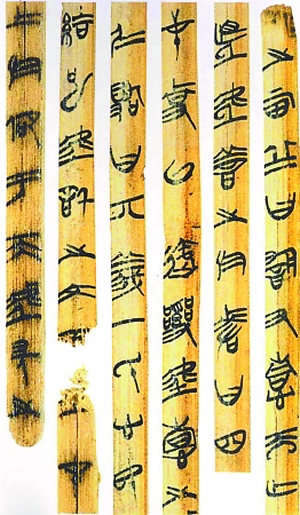
Later it says, “… bamboo books, which are believed to have been the main medium for writing in the Shang and Zhou dynasties. The very narrow, vertical bamboo slats of these books were not suitable for writing wide characters, and so a number of graphs were rotated 90 degrees; this style then carried over to the Shang and Zhou oracle bones and bronzes.” That sure sounds to me like the oracle bone script is not substantively older than the bronze script, and that they instead both came from the earlier bamboo-based script.
Then this page reiterates what we heard above; “The soft clay of the piece-molds used to produce the Shang to early Zhou bronzes was suitable for preserving most of the complexity of the brush-written characters on such books and other media, whereas the hard, bony surface of the oracle bones was difficult to engrave, spurring significant simplification and conversion to rectilinearity. Furthermore, some of the characters on the Shang bronzes may have been more complex than normal due to particularly conservative usage in this ritual medium…” This really sounds to me like oracle bone script is not older!
Other tertiary sources
Now that I’ve pulled all those non-committal and potentially conflicting quotes from wikipedia, the reader may be doubting my claim that oracle bone script is typically asserted to be older. To check that, I’ll just google various related terms, and tell you what some of the results say. I’ll also try to extract dates for the two scripts from the search results that seem remotely reputable (since wikipedia didn’t really give us a date for bronze script).
Okay, I did that search… and it was a pretty trash experience, epistemically speaking. One pattern I noticed is that sources were constantly conflating the dynasty range (whether Shang or “late Shang”) with the date range for the inscriptions.
Here are a few examples from sources with some degree of repute.
The Britannica article says that “The earliest known inscriptions” were the oracle bones. It also says “By 1400 BCE the script included some 2,500 to 3,000 characters”, which I think is not a date we have evidence for. It then says, “Later stages in the development of Chinese writing include the guwen…” which links to a page that sounds like “Guwen” is the bronze script.
This article on a popular Chinese language learning site claims that “The earliest Chinese characters were created using pictures or pictographs, which were originally inscribed on clay pottery and bone and then later on bronze and other metals.” and later “Bronze Writing evolved from Oracle Bone Script.” It does not mention bamboo writing.
This page from a Rutger’s professor seems to have pretty good SEO, because it was on the first page for multiple of my search terms. Reading down it, I see several yellow flags in the form of claims that contradict most of what I’ve read elsewhere. It also seems like said professor is primarily a chemist. He cites “Bronze writing” as 1400 BCE to 700 BCE, but also cites “Oracle-bone writing” as 1600 BCE 1100 BCE, which, again, I don’t think are evidenced dates.
This random page from the Harvard Art Museum says “Inscriptions cast into Shang bronze ritual vessels are among the earliest extant examples of Chinese writing.” and “Aside from bronze inscriptions, oracle bones … are the only other extant evidence of writing practice from the Shang dynasty.” This reads to me as not making a claim about which of the two are older.
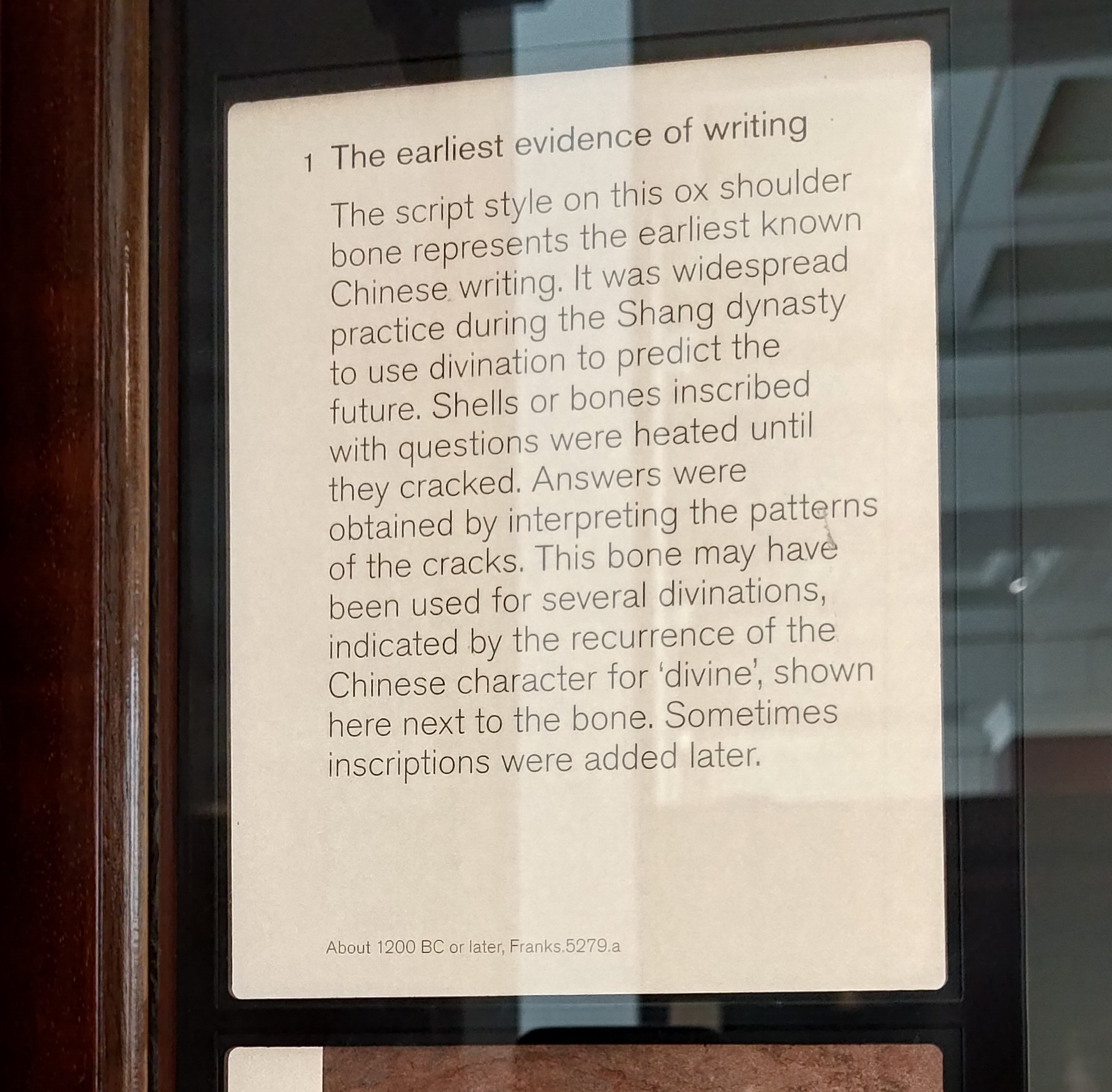
Lastly, I recently went to the British museum, which had an oracle bone inscription on display. Here’s what the sign said;
Again, no mention of bronze scripts.
I’m pretty weirded out by the fact that I have failed to find a specific date for the earliest bronze inscriptions. You would think that this would be a pretty clear question to get an answer to. The description on the cover of “A Source Book of Ancient Chinese Bronze Inscriptions (Cook & Goldin 2020)” says that it “…offers English translations and commentary on over eighty-two important bronze inscriptions, ranging in date from approximately 1200 B.C.E. to 200 C.E.” So that’s something, but I was unable to find a copy of this book.
From all this and other reading, it certainly sounds like bronze scripts are no earlier than the oracle bones.
Secondary sources
Now I’m going to try moving on to what I would call secondary sources. By this I mean academic books written by experts in the field.
The Ancestral Landscape (Keightley 2000)
In my past research, I’ve previously read the entirety of “The Ancestral Landscape: Time, Space, and Community in Late Shang China (ca. 1200–1045 B.C.)” by David N. Keightley. As far as I can tell, he is considered a reputable, and a leading (Western) researcher in the field.
Skimming through it again now, I realized that this book is mostly about what conclusions we can draw about the Shang people and culture using the oracle bone inscriptions as our source of information. It doesn’t talk that much about the development of the script, though it does talk a fair bit about the script itself. Unfortunately the word “bronze” does not appear in the index.
Does Keightley claim that oracle bone script is the oldest? Here’s a sentence I found in the preface; “These records, the earliest body of writing yet found in East Asia, were produced in the following way.” That actually sounds fair to me. Claiming that the oracle bones are the earliest body of writing is much different than claiming that bronze script descended from oracle bone script. I haven’t quite figured out how big the corpus of (late Shang) bronze script is yet, but it sounds plausibly small enough not to constitute a “body”.
Chinese Writing (Qiu 2000)
Now let’s check out one of the books heavily citied by the two wikipedia articles. https://starlingdb.org/Texts/Students/Qiu%20Xigui/Chinese%20Writing%20%282000%29.pdf This book is a 2000 English translation of the 1988 Chinese original. The preface makes it sound like it’s also been quite updated, so perhaps we can consider the information to be up to date circa 2000.
From the table of contents, there could be a lot of relevant sections, but it does not seem to contain the words “oracle” or “bronze”. (This PDF is not OCR’d so I can’t use the find function.) The index contains several page numbers for both scripts (which tend to have overlapping ranges). From reading through all these pages, it sounds to me like Qiu treats the two scrips as on-par with each other.
From page 29; “The earliest relatively substantial examples of ancient Chinese writing discovered so far are the bone and bronze inscriptions of the late Shang dynasty.”
From page 63; “It should be pointed out first that in terms of their structure, bone and bronze graphs exhibit different characteristics. During the Shang period the writing brush was the primary writing implement in use. … Graphs appearing on bronzes retain the features of brush-written characters, whereas those written on bone do not. As the Shang rulers frequently made divinations, the number of divinatory notations that had to be inscribed on bones was quite large. Inscribing characters on a medium as hard as bone is a time-consuming and strenuous task. For the sake of efficiency, engravers out of necessity altered the forms of the brush-written characters… Bone script can be viewed as a rather peculiar form of the popular script of that era, whereas the bronze script of that period for the most part may be viewed as a formal script.”
So without going deeper and reading the whole book, my judgement is that this source does not support the idea the oracle bone script precedes bronze script, and instead supports the idea that they were contemporary scripts adapted to their function and medium.
Overall, this book seems extremely reasonable and balanced.
The Origin and Early Development of the Chinese Writing System (Boltz 1994)
Reading through the index, it says almost nothing about bronzes. It seems to mostly be an academic defense against the (then) popular idea that Chinese was pictographic. I now realize that while this book was heavily cited by the wikipedia page for oracle bone script, it was not cited on the page for Chinese bronze inscriptions. Oops! It does not seem to make a strong claim about oracle bone script in particular being the predecessor of all other Chinese scripts.
Conclusion
My conclusion is that oracle bone script is not a predecessor to bronze script. Instead, they both existed at the same time as each other and as a more common script that has not survived due to being written on perishable materials like bamboo.
However, my conclusion is also not that “historians were wrong” — it’s that all the tertiary sources are wrong. This should have been an obvious hypothesis, but I failed to think of it.
So what happened? Why does everyone say oracle bone script is the older predecessor? I think there are several contributing factors.
Oracle bone script “feels” older. Both because it looks more primitive and because bones feel older than bronze.
It may be that technically, the oldest known date for an oracle bone inscription is slightly older than the oldest known date for a bronze inscription.
The dates of all the known oracle bones are tightly clustered in the 200 year range which also happens to be the beginning of the date range for bronze inscriptions. Since oracle bone script “died out” much earlier than the bronze script, that kinda makes it feel older.
Scholarship in early Chinese writing is niche, and mostly not translated into English.
Though this post is very long, it was only one day of research, and again, I am by no means an expert! So if you are, or happen to know key facts I missed, please let me know!
And if you’re a random bystander who’s considering going into research; hopefully this little adventure helped you decide. I honestly enjoyed it a lot.
An Egyptologist will tell you that hieroglyphs changed a ton over the millennia of use; this is true, but we’re talking about differences of a different magnitude. ↩︎
Actually Early Modern English. Old English is what Beowulf was written in, and is totally unreadable to a modern English reader. ↩︎
Throughout this post, all emphasis in quotes is mine. ↩︎
This is my post for day 22 of the Inkhaven writing retreat.
The basic promise of science is this; by using the scientific method, you can figure out how the world works, and thereby take better actions to get the outcomes you want. This is the primary justification for funding scientific endeavors with taxpayer dollars. There is of course also the justification that scientific inquiry has value in its own right. But this isn’t valued by everyone, and is overall a much harder sell.
In some fields, like astronomy, it’s clear that the main activity is observation and not manipulation. No one is expecting astronomers to figure out how to make the sun be less bright to reduce global warming. But I think a lot of people are still expecting that studying the deep nature of neutron stars gives us a better chance of discovering some kind of double-hyper-fusion, or something.
And people often talk about the danger of attempting to apply the knowledge gained from investigating nature. Whether it’s nuclear bombs or Jurassic park, the harms of science-fueled technological development have been vividly impressed into the public’s mind.
In contrast, I almost never hear anyone talk about the null outcome that some domains of science are substantially inactionable.
Investigating the mind is one such category with dubious applicability. Putting aside the hard problem of consciousness, I would claim that we still have basically no idea how “thinking” works. We have a lot of data about neurons and synapses, and also a lot of fMRI data, the value of which is very unclear. We have no shortage of ideas about how thinking could work. And at this point, we’ve literally built a brand new intelligence (using methods that specifically obfuscate the entire structure). But we still don’t know the basic, architectural principles behind the human mind.
Personally, I have some kind of moderately severe problem with the way my mind works, which can be expressed via attention, motivation or executive function. I spent a lot of my 20s trying to understand what was going on at the level of psychological investigation. Did I have false subconscious beliefs? Did I have underlying values that I wasn’t aware of? Did anything in my childhood cause this? And I figured out a lot of stuff! I outlined several models of my psychological content which resonated and were consistent with other facts about my life. But change was lagging.
Sometimes, when you do enough introspection to excavate an underlying belief, the realization of it causes the relevant problem to almost autonomously resolve itself. Perhaps you fantasized about getting a puppy but were conflicted about it making your house too messy. Through introspection you realize that you mostly wanted a puppy to cure your loneliness, and that you wanted a clean house to feel a sense of control. And now that you’ve realized this, it feels clear that a better solution to both of these is to put more focus on finding a romantic partner who would enthusiastically help you gain better skills to control your life. But my big problem was not resolving itself despite my “discovery” of some underlying content that seemed very related.
Another way to fix some motivation or executive function problems is to set up strong habits. Habits are an extremely real, extremely reliable neural/psychological mechanism that humanity has written about since Aristotle.
There are several self-help books that describe the phenomenon of habits in great detail. The habit will have a contextual cue or trigger. This trigger will cause you to take the habitual action. The action will then result in you experiencing a reward. This reward reinforces the trigger-action pair, making the habit more likely in the future.
These books are written in a frame of problem-solving; they have little diagrams or flow charts that help you figure out how to install or uninstall a given good or bad habit. But as I read through these books, brainstorming for hours and trying countless little modifications to my life, I found that nothing really stuck. The books are supported by a mountain of habit science, but I do not believe we have an equivalently supportive habit engineering.
Certainly some attempts to deliberately install habits work. Many of the habits you already have are from you starting to take actions that you thought would have positive effects, and being reinforced by that. But those were also likely easy enough that you didn’t need a whole habits framework to do it. Perhaps there is something like an efficient market for habits, where the habits that are worth the effort of installing are ones that you’ve already installed.
I think that failing to acknowledge this science vs. engineering or observational vs. interventional distinction is a generalized sin for self-help books, particularly the ones that claim to be based on science. It’s not an optimistic piece of advice, but keeping it in mind and tracking them separately can save you a huge amount of time.
It’s day 21 of 30 days of daily blogging at the Inkhaven writing retreat.
The social accountability structure is doing an excellent job at causing me to actually write something every day. This kind of structure is rare and valuable; you can’t just go out and get 40 people to do a daily goal with you and mutually support each other. I’m glad I took advantage of it. I’m also quite glad that I’ll have a little portfolio of 30 blog posts, like a kind of souvenir. Probably the most useful thing I’ll have gotten out of it is the information of what it was like when I tried to write every day. I’m getting lots of rapid data about how easy it is, what topics I end up choosing, and how my writing responds to a forceful incentive to publish faster. Even if I stop daily blogging, I can use this bundle of experience as useful data when I want to plan future writing, or reflect on my relationship to writing.
That said, I think that by day 20 the marginal information accumulation has kind of petered out. I don’t feel strained for ideas or anything, so I’m pretty sure the next ten days could just go exactly like the last ten.
Given that, I’ve been experiencing an increasingly strong sense of “I don’t wanna” in relation to the task of writing a post each day. Now, this feeling on its own doesn’t necessarily mean much. It’s pretty common for highly skilled or productive individuals to report that their hesitation to wake up early, do the hard work, get on stage again, etc. never goes away, and the key to succeeding was to build a system (internally or externally) such that they do it anyway, despite that feeling. So it would be kinda lame if I let this sense of “I don’t wanna write a post today” affect me in and of itself.
But when I look into that feeling a bit, part of what’s happening is that the writing doesn’t feel as valuable as I thought it might be.
A lot of how I’ve been writing daily posts is by just lowering my standards. I haven’t written anything that I’m embarrassed about, and it’s not like I’m dumping stream-of-consciousness morning pages onto the internet. But the posts are… just fine? They’re essentially all notably worse versions of what I “could” have written if I’d spent more time on them. I would like them to be better fact-checked, and illustrated, and with much more care in the construction of the expression. I want to take more time to find the phrases that really hit with resonance. It may be that writing three of the worse posts is more valuable to readers than me spending three times as long to make the better version of one of them. But… I don’t really want to write the worse versions? That is not very satisfying to my inner craftsman.
As you can see, I’m still figuring out how I feel about this.
I’m also getting less feedback and positive reception than I expected. This could be just down to the fact that I am doing no promotion of my content whatsoever, but it’s still a negative update on the value of writing.
There’s also the bit where the activity of getting to know the other people in the Inkhaven cohort has been, thus far, a direct trade-off against writing. I’ve mostly prioritized writing (and my day job) and so I really haven’t gotten to know people. This program feels like exactly the kind where you unexpectedly life-long friends, so I’m kind of sad about having to write mediocre blog posts instead of doing that.
This is my post for day 20 of the Inkhaven writing retreat.
Every day, everyone wakes up all around the world and gets down to business trying to achieve their values; raising their children, producing goods, having positive experiences, and generally staying alive. Much of life has the sense of trying to push forward toward something, towards your values, and being constrained or rate-limited somehow.
It’s easy to see how your actions are constrained by things like money, skills, or social support. These constraints are like physical walls delineating the room you can act within. Inside the room is all the actions you can take immediately and freely, whether or not they effectively achieve your values. Walls can be broken down, but it takes quite a lot more effort, planning, and hard trade-offs.
It’s less natural to look at your values themselves as constraints. You “could” swerve the car into the oncoming lane, but you overwhelmingly don’t want to.
I think it can be a useful perspective to view yourself as physically constrained by your values, just as much as you are constrained by money or skills, even if it’s a constraint that you’ll never try to overcome. (In this post I’m only referring to terminal values, or what philosopher Paul Tillich called ultimate concerns, which are the things you value in and of themselves. I am not including instrumental values, which are things you only value because they lead to other values.)
Values as constraints is a pretty funny way to look at things, like putting the cart before the horse. The primary relationship between your actions and your values is that your values are why you take the actions you do take. It’s not as if your values are “take as many actions as possible”.
But it’s still kinda true, though. Scott Garrabrant once quipped that an agent was something whose type signature was (A → B) → A. That is, if the agent predicts that action A will lead to outcome B, and the agent values outcome B, it will take action A. Similarly, (A → ¬B) → ¬A.
This can also be a useful perspective for viewing other people.
I have sometimes been confused about why some of my friends seemed to struggle with certain things. It was easy to consider that they might have had less skills, or had different life experiences, or sensory sensitivities, or different brain chemistry that produces more anxiety, or something. It took me longer to realized that they simply had values that I didn’t. Once I could internalize that they really did have those different values, it was obvious that their action space was more limited, and their struggles made sense.
Or, maybe other people are missing values that you have. This would give them more options for acting. This is one reason that powerful people are more likely to be be sociopaths. I physically could not take the action of hurting people in the way that many politicians or businessmen do. But they can take that action, because (in part) they literally don’t care. All else equal, a larger action space implies a higher probability of achieving your goal. Perhaps it is tempting to think something like “curse my pro-social values, if only I didn’t have them, then I could gain great political power, and with it, do higher-leverage pro-social things”. But like. That doesn’t really make sense. As a disclaimer, I don’t mean to imply that all politicians and businessmen are sociopaths, or that society is doomed (by this particular selection effect). Just that it’s something you should have in your model of society.
This idea applies less cleanly to people whose values are less stable and coherent. A more coherent mind might value both apples and oranges, with some weighing between them. If it has to make a decision that trades off between apples and oranges, then it will just apply the weights to decide. A less coherent mind might simply contain two subsystems, one which values only apples, and one which values only oranges. This mind would also have some kind of supervising system that controls when each subsystem runs. In this case, the conflict between the values will be a genuine conflict, and one of the subsystems might figure out how to destroy the other one. This is more like how I would describe becoming corrupted.


 The Nameless Virtue